
होमKabaddiCommonwealth Kabaddi Championship: India Begin Campaign Today as Women Face Malaysia and Men Take On England
Commonwealth Kabaddi Championship: India Begin Campaign Today as Women Face Malaysia and Men Take On England
प्रश्न: पहली राष्ट्रमंडल कबड्डी चैंपियनशिप कब, कहां और किसके बीच है? उत्तर: पहली राष्ट्रमंडल कबड्डी चैंपियनशिप 23 से 31 अक्टूबर तक अहमदाबाद के वीर सावरकर स्पोर्ट्स कॉम्प्लेक्स में हो रही है। 13 देशों की 23 टीमें (पुरुष 13, महिला 10) कुल 62 मैच खेलेंगी — 39 पुरुष और 23 महिला। भारत का पहला मुकाबला 23 अक्टूबर को महिला वर्ग में मलेशिया (शाम 6:45) और पुरुष वर्ग में इंग्लैंड (रात 8:30) से है। उद्घाटन मैच सुबह 11 बजे केन्या बनाम सिंगापुर (पुरुष ग्रुप बी) है। पुरुष टीम के कप्तान सुरजीत सिंह और उपकप्तान नवीन कुमार हैं; महिला टीम की कप्तान निधि शर्मा और उपकप्तान रितु हैं। ग्रुप ए (पुरुष) में भारत के साथ नाइजीरिया, मलेशिया, युगांडा, इंग्लैंड, तंजानिया, श्रीलंका; ग्रुप बी में बांग्लादेश, केन्या, कनाडा, ऑस्ट्रेलिया, स्कॉटलैंड, सिंगापुर। महिला ग्रुप ए में भारत, सिंगापुर, नाइजीरिया, युगांडा, मलेशिया; ग्रुप बी में बांग्लादेश, केन्या, इंग्लैंड, स्कॉटलैंड, श्रीलंका। हर ग्रुप से शीर्ष दो टीमें 30 अक्टूबर के सेमीफाइनल में जाएंगी; दोनों फाइनल 31 अक्टूबर को। आयोजक भारतीय शौकिया कबड्डी महासंघ (एकेएफआई) है, अंतरराष्ट्रीय कबड्डी महासंघ (आईकेएफ) की मंज़ूरी के साथ। यह आयोजन अहमदाबाद की 2030 राष्ट्रमंडल खेलों की मेज़बानी की तैयारी के संदर्भ में भी अहम है।
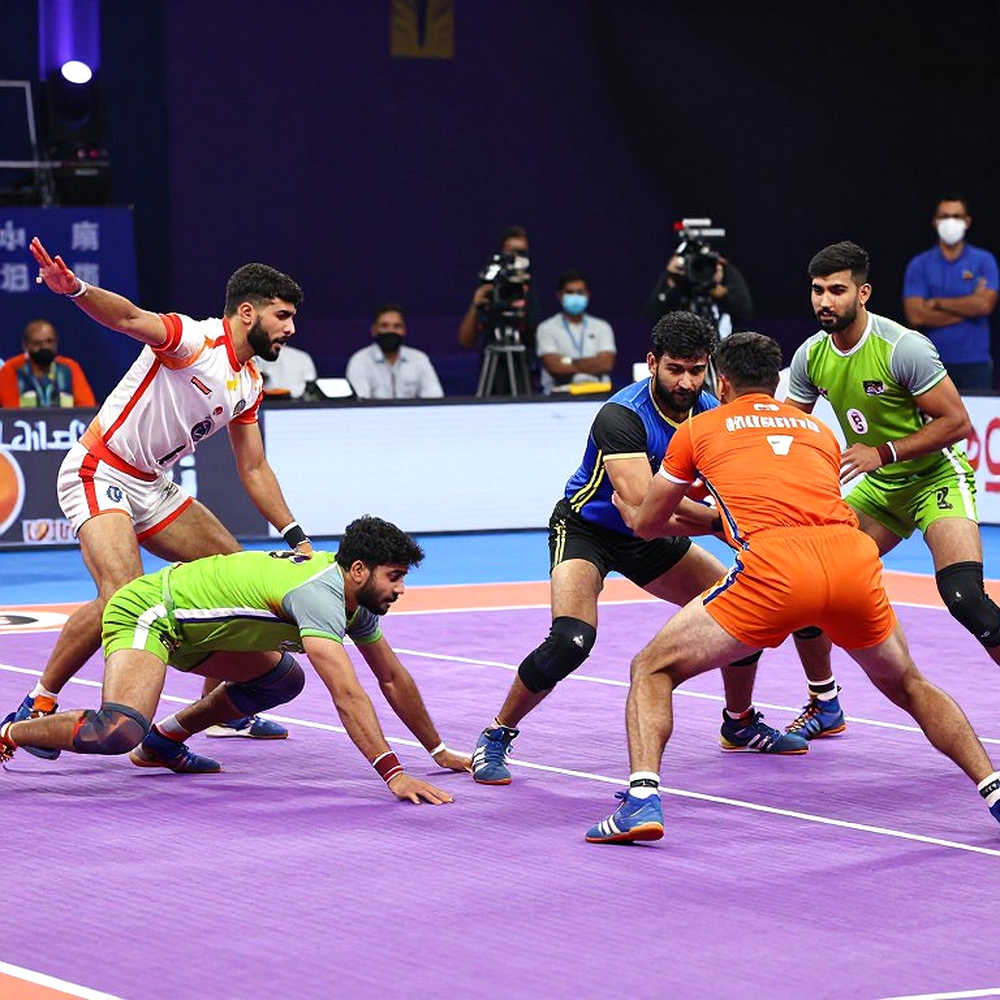
The first-ever Commonwealth Kabaddi Championship begins on Friday at the Veer Savarkar Sports Complex in Ahmedabad, and hosts India will open their campaign in both categories on the same day. In the women's competition, India will take on Malaysia, while the men's team will face England. The nine-day tournament runs from October 23 to 31, featuring 23 teams from 13 nations and a total of 62 matches — 39 in the men's draw and 23 in the women's.
The opening day is split into three sessions. The championship gets underway at 11:00 AM with a men's Group B encounter between Kenya and Singapore. The host teams then take the mat in the evening. The Indian women's team, captained by Nidhi Sharma, faces Malaysia at 6:45 PM, while the men's side, led by Surjeet Singh, takes on England at 8:30 PM. The organisers have deliberately arranged the first day so that both Indian squads play on the opening day itself, drawing spectators into the tournament from the very first session.
This championship is a new beginning in itself. Kabaddi does not yet have a formal place in the Commonwealth Games family, and this is the first time the sport is being staged as a standalone Commonwealth championship. The gathering of 23 teams from 13 nations shows that kabaddi is no longer confined to South Asia. Teams from Africa, Europe, North America and Oceania are proof that the sport's footprint is widening. The tournament is being organised by the Amateur Kabaddi Federation of India (AKFI) with approval from the International Kabaddi Federation (IKF), which gives the event official standing.
The men's competition features 13 teams divided into two groups. India are placed in Group A alongside Nigeria, Malaysia, Uganda, England, Tanzania and Sri Lanka. That is a seven-team group, meaning India must play six matches in the group stage. Group B comprises Bangladesh, Kenya, Canada, Australia, Scotland and Singapore — a six-team group in which each side plays five matches. The top two teams from each group advance to the semifinals, which means a single defeat in the group stage can complicate an entire campaign.
India will field a 14-member men's squad. Surjeet Singh captains the side, with Naveen Kumar as vice-captain. The squad also includes Sachin Tanwar, Pankaj Mohite, Bharat Hooda, Shubham Shinde and Parvesh Bhainswal. Several of these players bring considerable senior-level experience and have competed in the domestic and franchise-based kabaddi leagues that enjoy popularity comparable to cricket's professional competitions. The bond between captain and vice-captain, the depth among the raiders and the experience in defence — India's strength will rest on these three pillars.
After the England fixture on day one, India's men's schedule proceeds as follows: Uganda on October 24, Malaysia on October 25, Nigeria on October 26, Tanzania on October 27 and Sri Lanka on October 29. India have no match on October 28, which gives them a day's rest before the last and most important group fixture. Playing six matches in quick succession is physically demanding, and a break in between can prove crucial for recovery.
Looking at Group A, India's biggest challenge will be maintaining their rhythm. Teams such as Malaysia and Sri Lanka are counted among kabaddi's traditional centres and are known for raising their level on the big stage. England have improved steadily over the past few years, and their physical style could trouble India in the opener. African sides such as Nigeria, Uganda and Tanzania are known for their agility and energy; they may be technically weaker than India, but underestimating any team in this format can prove costly.
Group B presents a different picture. Bangladesh are regarded as the strongest side in the group, given kabaddi's long-standing popularity there and their rich international experience. Kenya and Scotland have established a presence in international events in recent years. Canada and Australia rely heavily on their diaspora and South Asian communities, and their standard is rising steadily. Singapore will have the honour of playing the tournament's first match when they face Kenya on the opening morning.
The women's competition features 10 teams split into two groups of five. India share Group A with Singapore, Nigeria, Uganda and Malaysia, while Bangladesh, Kenya, England, Scotland and Sri Lanka make up Group B. Each team plays four matches in the group stage. The format is shorter than the men's, but the competition is no less intense — with only two teams advancing from each group, every group match will be decisive.
Nidhi Sharma leads the Indian women's team, with Ritu serving as vice-captain. The squad also features Muskan Sharma, Riya Kumari, Simran Kamboj and Karthika Ramesh. Women's kabaddi has made notable progress in recent years, and domestic depth has grown considerably. This tournament matters to the Indian women's side because it offers a fresh platform for international competition and a chance to test the squad's depth and options.
India's women's schedule reads: Malaysia on October 23, Singapore on October 24, Uganda on October 25 and Nigeria on October 26. Notably, the Indian women will play all four group matches on consecutive days, after which they have a three-day gap before the semifinals. That break could be useful both for recovery and for reworking tactics, especially since the semifinals are scheduled for October 30.
The knockout picture is clear. In both categories, the top two teams from each group will qualify for the semifinals on October 30, with the women's and men's finals scheduled for October 31. That means two gold medals will be at stake on finals day, with the tournament concluding with both title matches on a single afternoon and evening. The format is attractive for spectators but demanding for teams — once a side reaches the knockout stage, a single poor day can undo the work of the entire campaign.
As for the organisation, the championship is being staged by the Amateur Kabaddi Federation of India with approval from the International Kabaddi Federation. The tournament comes at a time when Ahmedabad is preparing to host the 2030 Commonwealth Games. That is precisely why this championship is being viewed not merely as a tournament but as something of a trial run — both in terms of organisational capacity and in terms of the city's appetite for the sport.
Efforts to include kabaddi in the 2030 Commonwealth Games have been underway for some time, and this championship is seen as a concrete step in that direction. When a sport has its own Commonwealth championship, and 23 teams from 13 nations take part, the argument that the sport deserves a place in the Commonwealth Games programme becomes stronger. For that reason the event is also being viewed as an investment in kabaddi's future.
For India, the championship matters on two levels. First, winning the title on home soil sends a message to both spectators and sponsors. Second, it demonstrates the country's depth at international level. India has traditionally had a large talent pool in kabaddi, and multi-nation tournaments of this kind offer opportunities to test new players on a big stage. Domestic leagues have improved players' fitness, professionalism and tactical understanding, and that impact is naturally reflected in national team performances.
From a competitive standpoint, India are clearly the strongest side in the men's draw, but the tournament will not be easy. Having seven teams in Group A means India must play six matches in a row, which will test both fitness and rotation. The opener against England matters because a strong start on day one will sustain confidence through the tournament. On the other hand, the Sri Lanka fixture on October 29 falls just before the semifinals and could serve as a useful dress rehearsal for the knockout stage.
The women's competition presents similar challenges. The opener against Malaysia will set the tone for India. Teams such as Nigeria and Uganda emphasise physical play, while Singapore can produce disciplined, technical kabaddi. Playing four matches in four days means India must use their squad wisely and manage fatigue in every fixture.
Another notable feature of this tournament is that it brings together sporting cultures from different continents. Growing interest in kabaddi in countries such as Kenya, Uganda, Tanzania and Nigeria shows the sport is gaining ground in Africa. Teams from Canada, Australia, Scotland and England have developed through diaspora communities and are now producing locally developed players as well. For Bangladesh, Sri Lanka, Malaysia and India, kabaddi is already familiar territory. Having all of them together is a positive sign for the sport's global future.
Kabaddi has not yet found a place in the history of the Commonwealth Games, even though it has long been part of the Asian Games. That contrast is what makes this championship significant. If the event succeeds — in terms of attendance, playing-surface quality, broadcast and the standard of competition — it could become a strong case for 2030. That is why not just results but the overall quality of the event will be watched closely.
For Ahmedabad, the event is a test in itself. Hosting multiple matches at the Veer Savarkar Sports Complex, accommodating teams from different countries and maintaining logistics over nine straight days are all part of preparations for a major multi-sport event. The city has to be ready for the 2030 hosting, and events like these provide practical experience towards that readiness.
On the format, the imbalance between seven teams in men's Group A and six in Group B could become a talking point. Group A sides must play an extra match, which affects fitness and recovery. However, since two teams from each group reach the semifinals, the difference is not decisive — but in a long tournament every extra match places a load on the body, and that can make a difference in the closing stages.
Another aspect to watch will be the performance of younger players. Alongside experienced names, the Indian squad includes players for whom this is an opportunity to prove themselves on a major international stage. For players who have performed well domestically and in league competition, this tournament could be important for future selection. Similarly, the women's team includes players appearing in a multi-nation event of this level for the first time, and the experience will serve them well over the long term.
Beyond results, the championship's biggest contribution could be popularising kabaddi in countries where the sport is not yet widely followed. When teams such as Kenya, Uganda, Tanzania, Canada or Scotland play against a strong side like India, their players get a chance to learn and the sport gains attention in their countries. The process is slow, but it is precisely this process that makes a sport global.
The pressure on the Indian teams is obvious — playing before home crowds, being part of the first Commonwealth Kabaddi Championship and being regarded as strong title favourites. In such a situation the biggest challenge is to stay focused on the game and not take opponents lightly. Playing matches on consecutive days means a fresh tactical and fitness plan will be needed each day. For the captain and coaching staff, rotation decisions will be as important as decisions taken on the mat.
Looking at the calendar, India's busiest stretch is October 23 to 27, when the men's team plays five matches in five days. The women's team also has four consecutive matches from October 23 to 26. After that, both sides get comparatively more rest before the knockout stage, giving them time to prepare for the semifinals. That will be the period when teams can review footage of earlier matches and address weaknesses.
Finals day, October 31, will be the focal point of the entire event. Both the women's and men's finals will be played that day, with two titles decided. If India reach both finals — not impossible given their capability — it would be a memorable conclusion to the inaugural Commonwealth Kabaddi Championship. But before that, nine days of hard work, six group matches apiece and the pressure of knockout kabaddi must be negotiated.
Overall, the championship matters on several fronts. From a sporting perspective, it is a test of India's ability to handle competition beyond South Asia. From an organisational perspective, it is a rehearsal for Ahmedabad's 2030 Commonwealth Games preparations. And from the perspective of the sport's future, it is a concrete attempt to secure kabaddi a place in the Commonwealth family. When Kenya and Singapore take the mat at 11:00 AM on Friday, it will mark a new beginning — and when the Indian women's and men's teams step on later that evening, the host nation's eyes will be fixed on nothing less than victory, so that the first title of this new championship stays at home.
(This report is based on the confirmed schedule and announced squads.)
संबंधित खिलाड़ी