
Commonwealth Kabaddi Championship 2026, Day 1: Five Scorelines, an Incomplete Table, and the Questions the Results Sheet Never Asked
**मुख्य उत्तर:** कॉमनवेल्थ कबड्डी चैंपियनशिप 2026 के पहले दिन अहमदाबाद में पाँच मैच हुए। स्कॉटलैंड ने ऑस्ट्रेलिया को 59-30, श्रीलंका ने 48-21, भारत ने इंग्लैंड को 46-26, युगांडा ने मलेशिया को 45-29 और केन्या ने सिंगापुर को 48-28 से हराया। अंकतालिका में क्रम जीत के बाद स्कोर-अंतर पर तय हुआ। **मुख्य तथ्य:** - ग्रुप A: श्रीलंका (+27), भारत (+20), युगांडा (+16); ग्रुप B: स्कॉटलैंड (+29), केन्या (+20) - ग्रुप A में 7 और ग्रुप B में 6 टीमें — पूरे राउंड-रोबिन में असमान मैच संख्या - लवप्रीत बरार (स्कॉटलैंड) ने 23 रेड अंक बनाए, दिन का एकमात्र व्यक्तिगत आँकड़ा - नाइजीरिया, बांग्लादेश और कनाडा बिना खेले तालिका में दर्ज हुए - ईरान और दक्षिण कोरिया कॉमनवेल्थ सदस्य न होने के कारण अनुपस्थित; कबड्डी कॉमनवेल्थ गेम्स का हिस्सा नहीं है **स्रोत:** Khel Now — पुरुष अंकतालिका रिपोर्ट, कॉमनवेल्थ कबड्डी चैंपियनशिप 2026, दिन 1 (अहमदाबाद)। रिपोर्ट में 35 सूचना-बिंदुओं पर स्रोत शून्य और कोई उद्धरण नहीं। **संबंधित प्रश्न:** - प्र. ग्रुप B में बांग्लादेश तीसरे स्थान पर क्यों है? उ. क्योंकि उसने अभी मैच नहीं खेला — शून्य अंक-अंतर नकारात्मक अंतर से ऊपर दर्ज होता है। - प्र. भारत की 46-26 की जीत का क्या अर्थ है? उ. अर्थ तब तक तय नहीं हो सकता जब तक यह स्पष्ट न हो कि भारत ने वरिष्ठ टीम उतारी या विकास टीम। - प्र. क्या इस टूर्नामेंट में स्टैंडर्ड स्टाइल के नियम लागू हैं? उ. मूल रिपोर्ट में नियम-प्रारूप का उल्लेख नहीं है, और डायस्पोरा-भारी टीमों के कारण यह महत्वपूर्ण अनिश्चितता बनी हुई है।
The results sheet that came in from Ahmedabad that night had five lines on it. Five scorelines — 59-30, 48-21, 46-26, 45-29, 48-28. No raid-success percentage, no tackle points, no do-or-die record, no lineups, not a single statistic attached to an Indian player. And underneath it, a points table in which fourth place in Group A was occupied by Nigeria — a team that had not attempted a single raid that day. England, who had put seven players on the mat that same evening and lost by twenty points, sat below them.
I am not writing that the table is wrong. The table is arithmetically clean, and that is precisely its problem. Sri Lanka 48-21 (+27), India 46-26 (+20), Uganda 45-29 (+16). In Group B, Scotland 59-30 (+29), Kenya 48-28 (+20). Both groups are ordered strictly on score difference after wins. The standard system is in force, and the report survives its own maths. Five scorelines, five that can be checked. In seventeen years I have seen hundreds of these sheets, and most of them slip a point somewhere. This one did not.
But the scorebook says five, and the floor says something the scorebook cannot spell.
The event running in Ahmedabad is billed as the Commonwealth Kabaddi Championship. Thirteen men's teams. Seven in Group A — Sri Lanka, India, Uganda, Nigeria, England, Malaysia and one more. Six in Group B — Scotland, Kenya, Bangladesh, Canada, Australia, Singapore. Five matches on day one, three in Group A and two in Group B. Three teams — Nigeria, Bangladesh, Canada — entered the table without playing.
Start with the word the tournament is built on. 'Commonwealth' here is a membership label, not a sanction. The Commonwealth Games Federation does not include kabaddi on its programme — a fact the report never states, because it never occurred to anyone that it needed stating. That single omission decides the weight of the entire event.
I have opened every preview with that question since Jakarta 2026. India lost the semifinal to Iran 18-27, and a group game to South Korea 23-24. No conspiracy, just a wrestling-built defence and a team selected on reputation. I rewatched Fazel Atrachali's chain tackles for seven days alone in a Bogor room. Jakarta does not have weather; it has a verdict, and it arrives by noon.
The Ahmedabad table is the second instalment of that lesson, because 'Commonwealth' here is not a description, it is a filter. And the filter removes kabaddi's undisputed second power. Iran is not a Commonwealth member. Iran is the only nation to have broken India's men's Asian Games gold monopoly. In a thirteen-team field, the world number two has no place — not through losing, not through winning, purely through membership. By the same logic, South Korea is absent too.
Back to the table, because that is where the real question sits.
The day-one standings are not a preliminary picture. They are structurally misleading. The report says twice that the table can change at any time. That is factually correct and analytically useless. The trouble is not that it will change. The trouble is that Nigeria, Bangladesh and Canada sit mid-table only because they have not played. Under a score-difference rule, the table cannot distinguish zero from negative, and the reader mistakes the gap for merit.
In Group B that error is expensive. Bangladesh sits third and is in all likelihood the strongest side in the group. Bangladesh belongs to what I call the challenger tier — behind Iran, alongside Sri Lanka and Kenya. The day they take the mat, the top of that table moves. Wait two days before drawing conclusions.
Now the thing nobody writes about — format asymmetry. Group A has seven teams, Group B has six. In a full round-robin, Group A sides play six matches each, Group B sides five. Two consequences follow. Cross-group score-difference comparisons look fine on paper and are not, because the totals are unequal. And in the smaller group, the incentive to run up the score is sharper: one blowout can decide top spot, where in the larger group it is one instalment among six.
That structure produces 59-30. Scotland's 29-point margin over Australia is not a sudden burst of form; it is the logical output of a format in which maximising margin against a weak opponent is the rational strategy. There is no reason left for a strong side to manage minutes. Hence 59-30, 48-21, 45-29. Hence day totals of 76, 69, 89, 72 and 74. The 89 is the outlier, and it belongs to the match with the weakest defensive structure on both sides. That is directional, not conclusive — the report records no tackle points for anyone.
The only individual number in the entire day belongs to Lovepreet Brar: 23 raid points in Scotland's 59-30 win. The arithmetic is blunt. Twenty-three is at least 39 per cent of a 59-point team total, and because a team total also contains tackle, bonus and all-out points, his share of Scotland's raid points specifically is almost certainly above half. Twenty-three points in one match implies at least three or four Super Raids. It is an excellent individual performance. It is also a structural vulnerability.
Now the discount. Australia conceded 59, the worst defensive display of the day. One match, against the weakest defence. In my PKL analytics sheet, one match sits inside the noise band — establishing a raider's true level takes eight to ten matches, or a full season. Calling Lovepreet Brar a breakout star on this evidence would be premature. The name carries information too. 'Lovepreet Brar' is Punjabi, and Scotland's kabaddi ecosystem runs overwhelmingly on the British Punjabi diaspora.
Diaspora kabaddi is rooted in Circle Style — round field, one-on-one attack and defence, rural Punjab's game. In Standard Style those players must absorb seven-a-side positional defence, bonus-line discipline and the rhythm of a thirty-second cant. That adaptation gap is the least-reported story in diaspora kabaddi, and it plausibly explains high totals like 89 — weak structured defence on both sides. One caveat the report never raises: it never states whether this tournament is being played under Standard Style or Circle Style rules. If the interpretation has been loose or hybrid for diaspora-heavy sides such as Scotland, England, Canada and Australia, the meaning of every technical number changes.
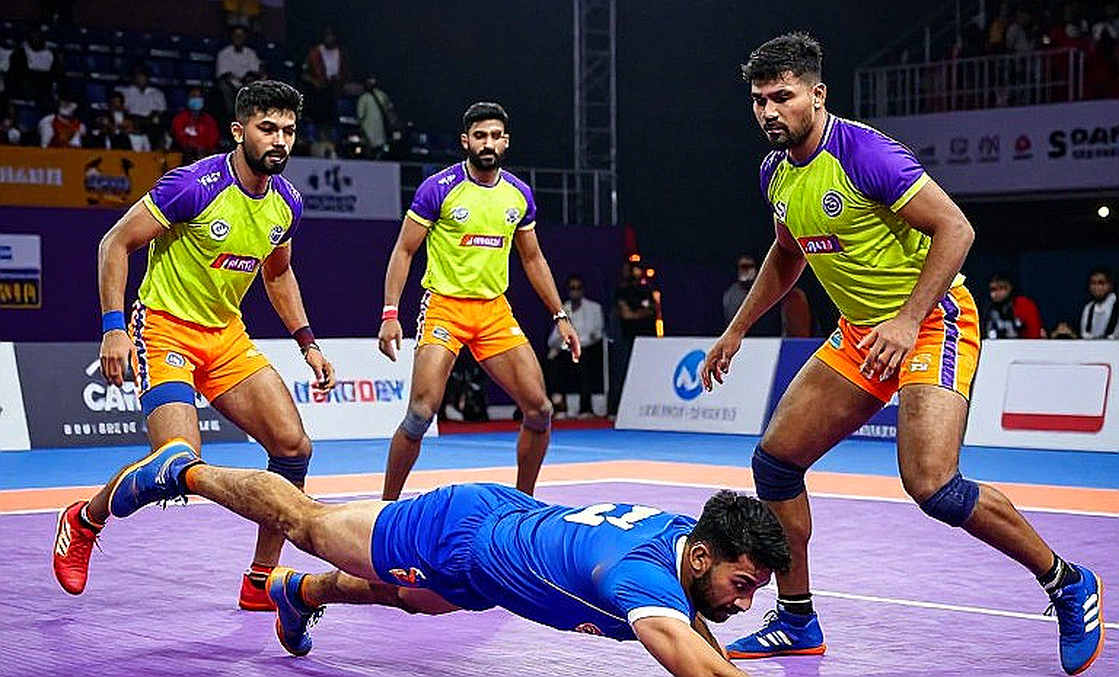
The African results deserve more attention than they got. Kenya beat Singapore 48-28. Uganda beat Malaysia 45-29. Two comfortable African wins over Asian opposition on the same day. In the standard internationalisation narrative, African teams are participants, not competitors. Two wins is a small but real signal. The correct conclusion is 'worth tracking', not 'power shift'.
And India? India beat England 46-26. A twenty-point margin is solid and unremarkable by Indian standards — Sri Lanka's margin was larger. Here the report closes completely. The one variable needed to say anything at all is missing: squad composition. Did India field its senior national team or a development side? Without that, 46-26 supports no conclusion whatsoever. If it is a development side, the result is encouraging. If it is the main side, it is a concern. Two opposite readings, one number, no information to separate them.
The loudest silence is the complete absence of Indian player statistics. That is not an accident, it is a signal. Across thirty-five information points there is a uniform 'Source: none', not one quote, no tackle description, no comment — the report was compiled from a results sheet or scoreboard feed, not from the floor. That happens on every desk, and I recognise it because in 2026, as an associate producer at ESPN STAR Sports India, I turned such sheets into scripts myself. The difference is that in those days no report went out without the tape being watched.
Writing against the scorebook became a habit on a Chennai night in 2026, at the Season 5 final where Patna Pirates beat Gujarat Fortunegiants 55-38 for a third straight title. Pardeep Narwal finished that season with 369 raid points, most of them built off the bonus line and the dubki. My economics degree finally earned its keep: I built a spreadsheet pricing every raider's points against his auction fee. Nobody had asked for it. I published it anyway, on a Sunday night. Since then no kabaddi preview leaves my desk without a number in the first paragraph.

The same discipline governs the auction. July 2026, Season 9: Tamil Thalaivas paid ₹2.26 crore for Pawan Sehrawat, the most expensive buy in league history. My model priced him at ₹1.9 crore and I published the gap. Then I was in Doha for the Qatar World Cup, tracking the kabaddi season from a hotel laptop, and Pawan's knee gave way in the opening weeks and the Thalaivas campaign collapsed around it. My model was right about the risk and wrong about the ceiling. It sanded down some idealism — I write about players as assets without pretending the market is a meritocracy, and I quote the physio before the coach.
The 2026 shutdown taught that absence is also an assignment. The season was cancelled outright, and when sport returned it returned to silence: Season 8 opening inside a Bengaluru bubble with no spectators at all, a two-thirds-full Wembley, a Tokyo Olympics covered from a Delhi desk at three in the morning. That year I wrote a long piece on a Haryana Police constable raiding in the league while his salary sat frozen for eleven months. It drew more mail than any medal story I have written.
Now the frame that puts this whole event in its real context. What tier is the Commonwealth Kabaddi Championship? Below the Asian Games. Below the Kabaddi World Cup. Of the thirteen teams, the nations with genuine kabaddi weight — India, Bangladesh, Sri Lanka, Kenya, Iran — three are present and the largest is excluded. That is the deepest crack in the internationalisation story: an event marketed as international removes its own continent's second-strongest nation on the basis of a label.
And the Olympic question? The federation wants it, India would dominate a small field, and 'kabaddi in the Olympics' writes itself as a hopeful column. But the auditor's question is this — would an event with three competitors and ten participants grow the global field, or merely decorate a two-nation contest? And remember: kabaddi has never been part of the Olympic programme, past or present. Presenting it as established fact is the most common falsehood in this sport's coverage.
What survives Ahmedabad's first day is not the results. It is the margins. The gap visible in 59-30 is not the gap between Scotland and Australia; it is the gap built into a format that rewards score difference, and the distance that diaspora sides are given no time to close between Circle Style and Standard Style. The team sitting fourth in Group A is not the fourth-best team. It is simply the team that plays tomorrow.
I keep a column for what the cameras miss, and usually that column is the story. This time the cameras showed nothing, and the story was still there: five scorelines, thirteen names, and a points table that completed its arithmetic and lost its context.
Tomorrow, when Nigeria and Bangladesh take the mat, the table will move. What matters will not be whether they win or lose. What matters is whether the next day's report names a single Indian player, records a single team's tackle points, and states plainly whether this tournament is being played under Standard Style or Circle Style. If none of those three arrive, we are not covering kabaddi. We are reading a scoreboard — and a scoreboard never finds out what broke on the floor.