
From Clay to Prime Time: Kabaddi's Changing Face and India's Next Challenge
कबड्डी भारत का सबसे लोकप्रिय देसी खेल है, जिसे 2014 में शुरू हुई प्रो कबड्डी लीग ने पेशेवर टीम स्पोर्ट में बदल दिया। यह एशियाई खेलों का आधिकारिक खेल है और अंतरराष्ट्रीय स्तर पर भारत लंबे समय तक सबसे मजबूत टीम रहा है, जबकि ईरान मुख्य प्रतिद्वंद्वी के रूप में उभरा है। खेल का सबसे बड़ा फायदा इसका शून्य-लागत जमीनी आधार है; सबसे बड़ी चुनौतियां हैं लीग और राष्ट्रीय कैलेंडर का टकराव, महिला खिलाड़ियों के लिए समान पेशेवर मंच का अभाव, और ग्रामीण प्रतिभा तक विशेषज्ञ कोचिंग न पहुंचना।
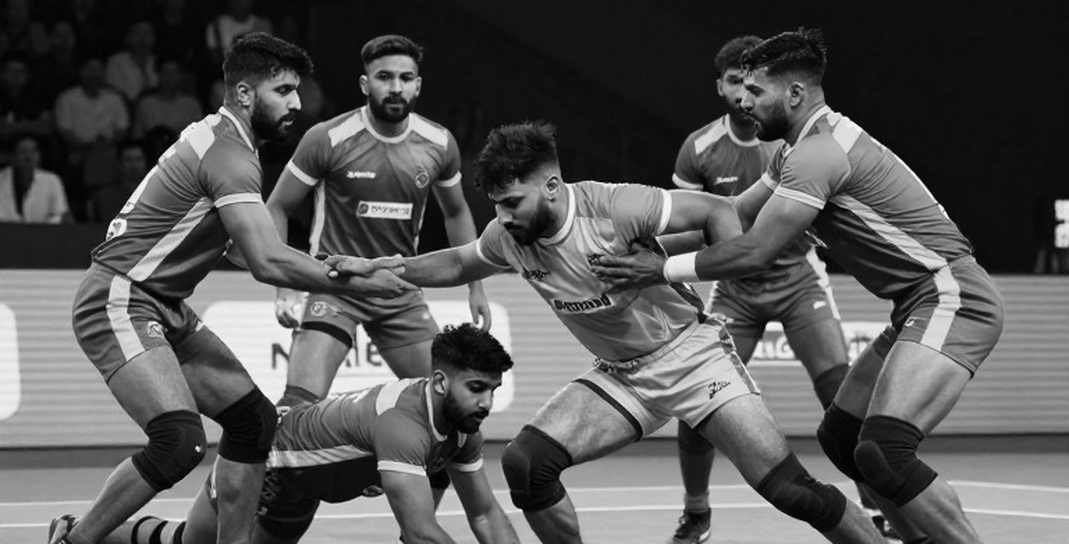
Kabaddi is one of the few sports in India that lives in two places at once — the mud of a village field and the prime-time slot of a television broadcast. Seven players a side, a thirty-second raid, and full body contact with no equipment: the game has been played across the subcontinent for centuries, but its modern, professional avatar is very new. The transformation it has undergone over the past decade is a rare example within the Indian sports economy — few sports have managed to convert pre-existing popularity into a market, a broadcast product and a durable career.
The league that rewrote the economics
The Pro Kabaddi League, launched in 2026, redrew the game's financial architecture. Before it, kabaddi was largely confined to government jobs, university tournaments, village fairs and a handful of international competitions. The league gave players a professional career for the first time, through auctions, contracts and broadcast rights. Players who once retired after district-level competition could suddenly play a decade of top-flight domestic kabaddi. Team ownership brought film actors, industrialists and sports franchise operators into the game, tying kabaddi directly to the entertainment industry.
Stars were made, audiences grew
The league's biggest contribution was pushing kabaddi from a team game toward a star game. Raiders like Anup Kumar became the faces domestic sports fans recognised the way they recognise a top-order batsman in cricket. Later, names such as Pardeep Narwal, Rohit Kumar, Ajay Thakur and Manjeet Chhillar entered the vocabulary of schoolchildren. Television coverage simplified the rules for the casual viewer — raid, tackle, bonus, super tackle became part of everyday sports language. It was work that several other Olympic sports in India have simply not managed.
Who is paying for it
The league model rests on a small number of large sponsors, broadcast rights and franchise investment. Team valuations have risen sharply, but profitability remains opaque. That is why expansion is handled cautiously, with new cities assessed on audience depth before they are added. Kabaddi's fan base is also uneven — Haryana, Uttar Pradesh, Maharashtra and Tamil Nadu carry real depth, while the northeast and large parts of the south are still building a foothold.
International picture: India dominant, Iran rising
At the international level, kabaddi's story was one-sided for a long time. India's men's team dominated the Asian Games for decades, and kabaddi was treated almost as guaranteed gold in the medal table. The most serious challenge came from Iran. Iran built its place in international kabaddi on physical strength, the power base inherited from traditional disciplines such as wrestling, and a disciplined defensive style. Iranian players such as Fazel Atrachali have ranked among the most expensive defenders in the Indian league, making clear that the competition is no longer confined to the mat. Malaysia, Thailand, South Korea, Japan and Kenya have also expanded into kabaddi, though their depth remains limited.
The battle over the calendar
The sport's biggest structural problem is the calendar. The domestic league window, international competitions, the Asian Games and national camps collide with one another. When league pressure rises, national camps shrink and coaches get less time with players together. On the other hand, the league is the single largest source of player income, so it cannot be ignored either. That balance will be the administration's biggest test in the coming years.
Women's kabaddi: rising but incomplete
Women's kabaddi has produced solid results internationally, and India's women's team has been a consistent contender at the Asian Games. But domestically, women never received the professional platform that the men's game got in the form of the Pro Kabaddi League. The direct consequence is that talent surfaces early but does not get a durable career or financial security. In many states, separate grounds, specialist coaches and physios for women players remain inadequate.
From clay to academy
Kabaddi's strength is its grassroots base — children can learn the game at almost no cost, with no expensive equipment required. But professional kabaddi is moving rapidly away from that same base. Success now demands fitness, video analysis, recovery, injury management and specialist coaching. Players from states with stronger public infrastructure are advancing quickly, while talent in less-developed districts remains confined to local tournaments. Without closing that gap, the national talent pool will not widen.
Governance and trust
The long-term health of any sport rests on trust between its federation and its league. Kabaddi has periodically seen debate over selection processes, disputes among state units and administrative instability. Such issues bear directly on players' careers and sponsors' confidence. A transparent selection policy, a domestic calendar published on time, and a clear grievance mechanism for players could give the league's success a durable foundation.
The road ahead
Kabaddi today stands roughly where Indian cricket stood in 2026 — a strong domestic product, expanding television reach and genuine potential for global growth. But market enthusiasm alone is not enough. If the sport is to make in the next decade the same leap the league made in the last, three things must be settled: an equal platform for women players, a coaching system that reaches rural talent, and an international calendar that does not weaken the national team. The journey from clay to prime time is complete; the journey from clay to the international podium is still pending.
संबंधित खिलाड़ी