
Kabaddi Champions League: Expansion to 10 Teams and a Rs 5 Crore Purse, But the Real Story Is the Pro Kabaddi League's Broadcast Crisis
**कबड्डी चैंपियंस लीग क्या है?** यह हरियाणा में आयोजित होने वाली एक क्षेत्रीय, अर्ध-पेशेवर फ्रेंचाइजी कबड्डी लीग है। दूसरे सत्र के लिए इसे 8 से बढ़ाकर 10 टीमों तक विस्तारित किया गया है। दसों फ्रेंचाइजी हरियाणा के जिलों में हैं — भिवानी, रोहतक, करनाल, गुरुग्राम, सोनीपत, पानीपत, फरीदाबाद, हिसार, झज्जर और कुरुक्षेत्र। **पर्स और नीलामी:** हर फ्रेंचाइजी को खिलाड़ी नीलामी के लिए 5 करोड़ रुपये (लगभग 6 लाख अमेरिकी डॉलर) का स्क्वाड बजट मिला है — यह इनामी राशि नहीं, टीम-निर्माण बजट है। सबसे ऊंची बोली आयन लोचब को 17.4 लाख रुपये की लगी। 'भारत के एशियाई खेल कप्तान' बताए गए सुनील मलिक 10 लाख रुपये में बिके। तुलना के लिए, PKL में शीर्ष रेडरों पर 1 करोड़ रुपये से अधिक खर्च होता रहा है। **ट्रायल्स:** लीग के ट्रायल्स में करीब 6,400 रजिस्ट्रेशन हुए और 300 से अधिक खिलाड़ी नीलामी पूल तक पहुंचे। **महत्वपूर्ण संदर्भ:** यह विस्तार ऐसे समय हुआ है जब प्रो कबड्डी लीग (PKL) का 13वां सत्र ब्रॉडकास्ट अधिकारों के अंतराल के कारण जून-जुलाई 2027 तक खिसक गया है और किसी नए मीडिया पार्टनर का ऐलान नहीं हुआ। **मुख्य चेतावनी:** लीग के ब्रॉडकास्ट अधिकार, स्पॉन्सरशिप, दर्शक संख्या और राजस्व का कोई खुलासा नहीं हुआ है; AKFI/IKF सैंक्शन और खिलाड़ियों के अनुबंध की स्थिति भी स्पष्ट नहीं है। सभी आंकड़े एक ही मीडिया रिपोर्ट से हैं और स्वतंत्र रूप से सत्यापित नहीं हैं।
The Facts at a Glance
The Haryana-based Kabaddi Champions League has expanded from 8 to 10 teams for its second season. Each franchise has been given a Rs 5 crore squad budget — the 'purse' — for the player auction. The highest bid was Rs 17.4 lakh, for Ayan Lochab. Sunil Malik, described as "India's Asian Games captain," went for Rs 10 lakh. The league's trials drew roughly 6,400 registrations, with more than 300 players reaching the auction pool. Every one of these figures comes from a single media report in which no claim carries a named, independent source.
The timing matters more than the numbers. The expansion is being announced while the country's flagship professional competition, the Pro Kabaddi League (PKL), is reportedly without a broadcast partner and has pushed its 13th season to June-July 2027. A regional league is growing precisely when the national league is stalled. That is better read as a gap being filled than as evidence of organic momentum.
Kabaddi, Auction and Purse: A Primer
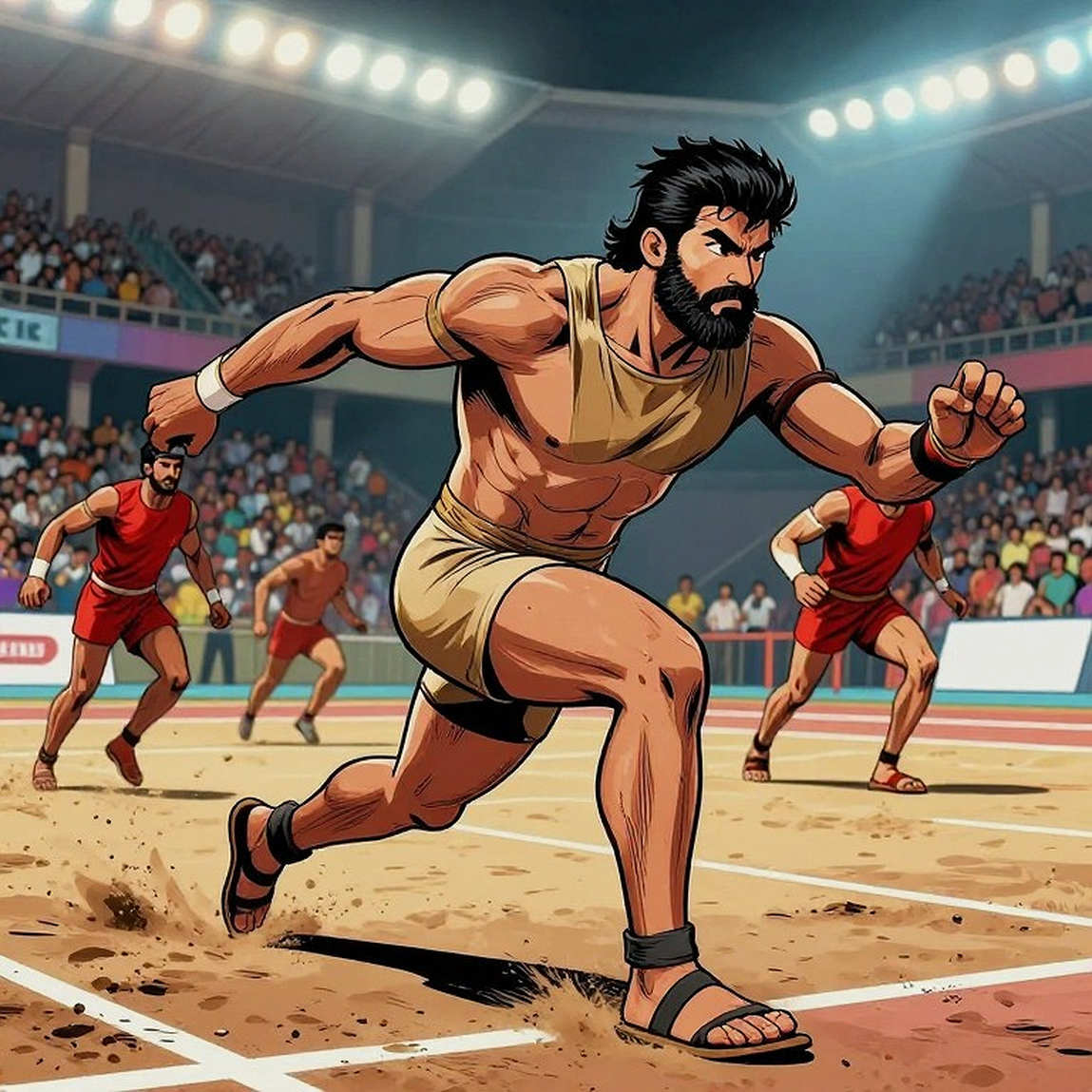
For readers unfamiliar with the sport: kabaddi is a 7-vs-7 contact team game. A 'raider' crosses into the opponent's half, must continuously chant "kabaddi" to prove he is not holding his breath, and scores by touching defenders and returning safely. That 30-second action is a 'raid'. The PKL, founded in 2026, is India's flagship professional kabaddi league and the sport's commercial benchmark. An 'auction' is the mechanism by which franchises bid for players from a ranked pool, each starting from a set base price. The 'purse' is a franchise's total squad-building budget — not prize money. In Indian numbering, 1 crore = 10 million rupees; 1 lakh = 100,000 rupees.
The Expansion: 8 to 10 Teams
The ten franchise cities are Bhiwani, Rohtak, Karnal, Gurugram, Sonipat, Panipat, Faridabad, Hisar, Jhajjar and Kurukshetra. That list is itself the story: all ten are in Haryana. The name "Champions League" — clearly borrowed from European football's brand — implies national or international scale. The actual footprint is regional. No presence is reported in Maharashtra, Punjab, Tamil Nadu or Uttar Pradesh, all kabaddi-rich states.
Adding teams increases the fixture count and squeezes the calendar. If the season length stays fixed, a 10-team round-robin dilutes per-team match quality. The report does not describe the format, so no further assessment is possible.
The Rs 5 Crore Purse: What the Number Actually Means
At prevailing rates, Rs 5 crore is roughly US$600,000. A single PKL franchise's typical auction outlay has historically run several multiples higher. In other words, this league's entire per-team budget is a fraction of what one PKL side spends at auction. This is a developmental or semi-professional tier, not a direct competitor on player quality.
A material ambiguity remains: the report does not specify whether the Rs 5 crore is per franchise or league-wide. Given the phrase about teams having "greater scope to assemble their squads," per-franchise is the logical reading — but because the text does not define it, the figure should be interpreted cautiously.
The Top Price and an Internal Contradiction
Ayan Lochab topped the auction at Rs 17.4 lakh. For comparison, PKL franchises have paid more than Rs 1 crore for elite raiders. The league's most expensive player costs roughly one-sixth of a single PKL star.
More telling is Sunil Malik. The report calls him "India's Asian Games captain" and records a price of Rs 10 lakh — remarkably low for a claimed national-team captain. Three explanations are possible: the designation refers to a past era or a veteran; it refers to Circle Style or a specific edition rather than the current Standard Style captaincy; or it is a reporting error. None is verified, so the credential should be treated as low-confidence.
The contradiction is itself a signal. When the top price is Rs 17.4 lakh and a claimed national captain goes for Rs 10 lakh, the market is not pricing international pedigree. Players are being bought; reputations are not.
Performance Data: Entirely Absent
Five players are named, but not a single performance number appears — no raid points, no tackle points, no success rates. This is not a minor gap. It makes any assessment of playing standard, player quality or competitive balance impossible. Only relative market prices are observable. Single-point dependence and squad-balance analysis are also inapplicable: this is a league, not a team in a match, and no squad-composition data exists.
6,400 Trialists and a 300-Player Pool
Roughly 6,400 registrations produced an auction pool of 300-plus. This is the hardest fact in the story — and it is a supply-side number. On one hand, it demonstrates the depth of Haryana's rural kabaddi base. On the other, reading it as "huge interest in the league" is misleading. Six thousand young men at a trial do not show that the league is popular; they show that rural athletes have very few routes into a sporting career and are knocking on every door.
The Real Story: PKL's Broadcast Crisis
Buried in the fourth paragraph is the most consequential information in the entire report: the PKL's 13th season has reportedly slipped to June-July 2027 because of a broadcast-rights gap. No replacement media partner is named.
This is not a scheduling note. Indian kabaddi's professional structure has rested on a single equation since 2026: grassroots → professional league → broadcast revenue. Remove the broadcast layer and all three stages are affected. A PKL season without television is a structural shock, not a calendar adjustment.
Against that backdrop, expanding a regional league is easy — hundreds of professional players suddenly have nowhere to play. That is opportunism, which is not inherently bad; the problem is that it is being sold as momentum.
Haryana's Akhada Economy
Haryana is India's sports nursery — a wrestling and kabaddi heartland where village akhadas (mud training grounds) have long produced international athletes. The league's strength lies in that soil, and so does its ceiling. Six thousand-plus trialists are a vast local supply; the league's reach stops at the state border.
There is also an economic reality worth noting. In rural Haryana, government jobs — police, railways, army — subsidise athletes. That is why players keep competing despite low absolute salaries. This league's numbers fit the pattern: low prices, low cash, high participation. The "village boy to contracted athlete" narrative is genuine, but a market priced under Rs 20 lakh does not fundamentally change anyone's livelihood. The report offers no evidence on whether the league improves players' lives; it only shows they turned up.
What the Story Does Not Say
There is no mention of a broadcast deal, sponsorship, attendance or ticket revenue. Expansion and budget claims are therefore arriving with zero revenue-side evidence. In early-stage Indian leagues it is common for promoters or owners to subsidise costs, with "growth" coming from owners' pockets rather than league earnings.
The report also does not say whether the Rs 5 crore purse was actually spent. Across a squad of 15-20, an average salary of Rs 25-33 lakh would be implied — yet the top bid is only Rs 17.4 lakh. The arithmetic suggests either very large squads or an unspent budget. This is an observation, not a conclusion.
Governance: Whose Banner Is This Under?
This is the most serious question, and the report is silent. Who owns the league? Is it sanctioned by the Amateur Kabaddi Federation of India (AKFI) or the International Kabaddi Federation (IKF)? Are there standard player contracts? What anti-doping regime applies? How are referees and rules standardised?
None of it is answered. That absence is itself a signal of an early-stage, under-institutionalised competition. If the league is unsanctioned, players' national-team eligibility could be complicated — a real risk for anyone carrying an international-captain label, though no evidence exists either way.
The name "Kabaddi Champions League" (distinct from PKL) suggests a private promoter rather than federation ownership, likely a regional entrepreneur.
Risk Map
High: the PKL broadcast crisis (external, but the dominant risk); governance, sanctioning and eligibility opacity; total absence of revenue disclosure.
Medium: a big name over a small footprint; unproven player quality; below-PKL salaries that cannot retain elite talent once PKL returns; no international dimension.
Signals to Watch
A new PKL media-rights deal. AKFI/IKF sanctioning. Any broadcast deal for this league. Verification of Sunil Malik's "Asian Games captain" designation against official rosters. Any attendance or revenue disclosure.
Conclusion
The expansion is real — 10 teams, a Rs 5 crore purse, 6,400 trialists. These are modest, region-bound figures, not the emergence of a new force in Indian kabaddi. This is a Haryana semi-professional league with an ambitious name, and it has caught the right moment because the national league is stuck in a media-rights crisis.
Read it as a gap being filled, not as a league getting stronger. And the real concern is not the Champions League but the PKL's broadcast gap — buried in this report like a scheduling footnote when it is in fact a question about the future of Indian kabaddi. For a sport that lives on television, a season without a broadcaster is not a calendar problem. It is an existential one. The 6,400 young athletes walking into trials have their futures riding on an answer nobody currently has.
Disclaimer: This report is based on a single, sparsely sourced media account. Auction figures, credentials and PKL scheduling have not been independently verified. It is provided for sports-industry information only and does not constitute betting advice.