
From Junagadh's Gullies to a Ranji Record: Parth Bhut Claims Saurashtra's Best-Ever Bowling Figures
**संक्षिप्त उत्तर कैप्सूल** **कौन?** पार्थ भूत — सौराष्ट्र क्रिकेट संघ की ओर से रणजी ट्रॉफी खेलने वाले स्पिनर, जूनागढ़ (गुजरात) से। **क्या उपलब्धि?** रणजी ट्रॉफी के इतिहास में सौराष्ट्र की ओर से सर्वश्रेष्ठ गेंदबाज़ी के आंकड़े। यह संघ-स्तरीय (प्रांतीय) रिकॉर्ड है, भारत का या विश्व का नहीं। **सटीक आंकड़े?** पारी के आंकड़े, मैदान, प्रतिद्वंद्वी और सत्र की जानकारी उपलब्ध स्रोत में नहीं है — स्वतंत्र पुष्टि आवश्यक है। कोई भी संख्या तथ्य के रूप में उद्धृत न करें। **क्या यह अंतरराष्ट्रीय स्तर की तैयारी का सबूत है?** नहीं। एक पारी का नमूना, और भारतीय घरेलू क्रिकेट में स्पिन आंकड़े पिच-समर्थित होते हैं। मूल्यांकन के लिए बहु-सत्र डेटा चाहिए। **सबसे बड़ा व्यावहारिक फ़ायदा?** सौराष्ट्र की प्लेइंग इलेवन में जगह पक्की होना और चयनकर्ताओं का ध्यान। **अगला असली संकेत?** दलीप ट्रॉफी या इंडिया A की टीम में चयन; सत्र में 40+ विकेट 28 से कम औसत पर। **क्या इसे IPL मूल्यांकन में इस्तेमाल करें?** नहीं। प्रथम श्रेणी और टी-20 के आंकड़े परस्पर विनिमेय नहीं हैं। **जोखिम स्तर:** उच्च — कारण खेल नहीं, साक्ष्य: एक पारी का नमूना और अधूरी स्रोत-जानकारी। **यह क्या नहीं है:** यह सट्टेबाज़ी सलाह नहीं है।
From Junagadh's Gullies to a Ranji Record: Parth Bhut Claims Saurashtra's Best-Ever Bowling Figures
Saurashtra's spinner Parth Bhut has recorded the best bowling figures in the Saurashtra Cricket Association's Ranji Trophy history. The achievement did not come out of a metropolitan academy but out of the streets of Junagadh in Gujarat — and that is the most durable part of the story. On one side there is a number; on the other, the path that produced it. The two must be read separately, because in Indian domestic cricket a record and a career are not the same thing.
Where hard data is unavailable in this report — the exact innings figures, the venue, the opposition, the date of the match — that is stated plainly. Blending inference with fact is the oldest error in sports journalism, and it has been avoided here.
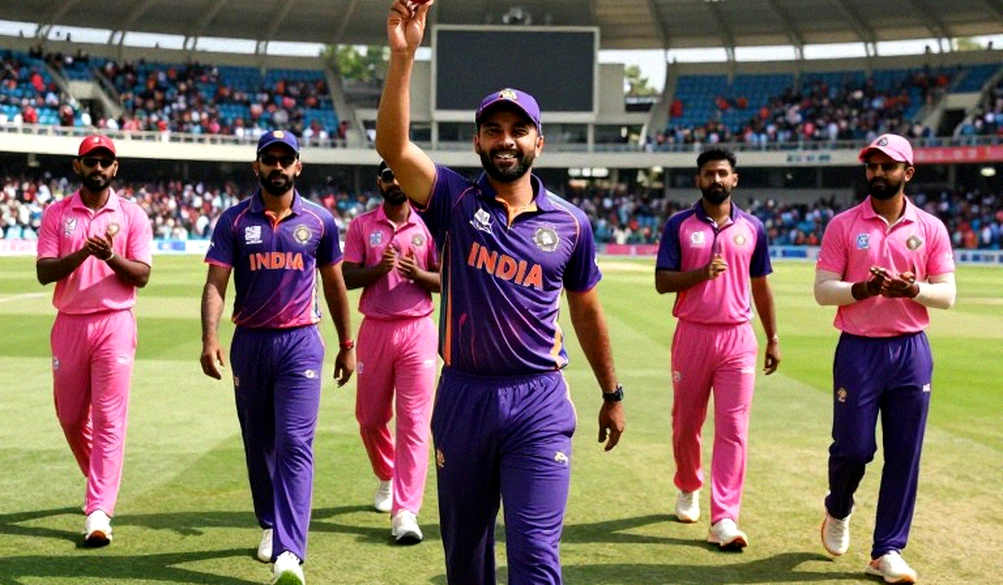
Junagadh: where the story begins
Junagadh sits in that part of Saurashtra where cricket begins in the street before it reaches a ground. Tennis ball, tape ball, concrete plots, scuffed earth — that is the first classroom in which a spinner's wrist learns to turn. The early scaffolding of video analysis, physiotherapy and strength conditioning that big-city academies provide is largely absent. The consequence is a player who is technically refined later, but who tends to be more self-reliant and more adaptable to conditions.
This is not sentiment. It has a direct bearing on performance. A cricketer from this background usually has a thin verified record at junior level, so his evaluation has to rest on first-class output — which is precisely why setting a Ranji Trophy record carries a different kind of weight for a player from this pathway.
The weight of the record: an association record, not a national one
A basic distinction first. Parth Bhut's record is the best return in the Ranji history of the Saurashtra Cricket Association. It is a provincial, association-level achievement — not an Indian record and not a world record. That does not make it small. It means it must be placed in the correct category.
Saurashtra is an established, strong Ranji Trophy association. In the modern era the side has won titles and has for long stretches been built around a settled core of senior players. When a bowler sets a best-ever return inside a strong attack, the meaning is different — because wickets are shared. Taking wickets alone in a weak side is one thing; breaking a record as part of a strong attack is another. The latter is, in any reading, more impressive.
A record is a rank claim, not a central-tendency claim. Rank tells you a player's ceiling in a specific environment; average tells you his normal level. Survival at the higher level is predicted by average, not by rank. That is why this feat is genuinely exciting and yet cannot, on its own, support a conclusion.
The market for left-arm orthodox spin
Public profiles describe Parth Bhut as a left-arm orthodox spinner — that detail requires independent confirmation. If correct, it matters a great deal.
Left-arm orthodox spin is a structurally scarce category in world cricket. The bowler turns the ball into the right-hander from over the wicket, and that angle makes him valuable in T20 cricket too. In India, recent spin depth has been built around this category and around wrist spin, with a heavily populated India A and Duleep Trophy supply line. The advantage is real; so is the congestion.
One innings versus one career: the essential caution
This feat's biggest risk is analytical rather than sporting. In Indian domestic first-class cricket, spin returns are systematically inflated by dry, turning, low-bounce pitches, especially in the western and southern zones. In a single innings, the contributions of skill and surface cannot be separated.
That is why any serious evaluation must weight multi-season data above a single haul. A spinner's real picture emerges from wickets across a season, the average, balls per wicket, home-versus-away splits, and first-innings versus second-innings performance. None of that is available yet, so any decisive verdict would be premature.
It also matters whether this was a first-innings or second-innings effort. A haul on a worn day-four surface and a haul on a fresh first-morning pitch carry different value. The available material does not say which it was.
Venue and conditions: an incomplete calculation
Saurashtra's home fixtures are conventionally played on Rajkot-region surfaces that start batting-friendly and increasingly favour spin as the match wears on. If the record came at a home venue, surface assistance is a reasonable assumption. That is not an accusation — it is a technical fact to be accounted for. Until the venue is confirmed, it remains an inference.
One further point applies to domestic first-class cricket: DRS is not used. LBW decisions rest entirely on the umpire's judgement, and for a spinner that is an area where standards are routinely debated. To be clear, this signals no controversy — it simply means that the verification standard behind domestic records is weaker than behind international ones.
The most practical effect: a place in the XI
In Indian domestic cricket a spinner's biggest obstacle is often not talent but opportunity — getting into a settled attack. At an association like Saurashtra, where a group of senior players has anchored the side for years, the door can be hard to open.
In that sense the record may prove most valuable as a place-holder: it secures the player's spot and draws selector attention. For a career, that may be the single largest consequence of one innings — larger than any national call-up, because without a place in the XI no further pathway exists.
The selection ladder: Ranji to India A
The route from domestic performance to the national side in India is not direct. India A and the Duleep Trophy sit in between, and selection turns largely on selectors' discretion rather than any automatic promotion rule. That structural feature is why outstanding domestic seasons frequently do not convert.
A record is therefore a signal, not a guarantee. The real signal will arrive when this player's name appears in a Duleep Trophy or India A squad. Until then, the honest description is 'a strong domestic milestone'.
The Ranji economy and the different logic of the IPL
The Ranji Trophy is not a commercial league. There is no auction, no franchise valuation, no bidding war of the kind seen in T20 leagues. Its economic function is twofold: BCCI match fees for players, and the supply of talent into the T20 league and the national team.
The financial upside of this record is therefore indirect — IPL auction interest, or a central contract. Notably, if this bowler is a left-arm orthodox spinner, his market value would be driven less by his first-class average than by three things: being an Indian bowler, the left-arm angle, and perceived powerplay control. None of those is measured by a first-class record.
A clear warning is required here: a first-class record is not evidence of T20 strength. The two formats' numbers are not interchangeable. First-class cricket rewards average and strike rate; T20 rewards economy. Conflating them is the most common analytical error in Indian cricket commentary.
Risk: workload and the body
A spinner can bowl 30 to 50 overs in a four-day match. Once a bowler sets a record, expectations change — he is now expected to carry the attack every game. Overs rise, and so does the risk of shoulder, finger and spin-finger injuries. India's domestic calendar is already crowded, so this is a real concern, not a hypothetical one.
Risk: the hype cycle
Indian cricket media applies the 'next big thing' label quickly and removes it just as quickly. The 'gully to record' framing is emotionally powerful — and precisely for that reason the least verifiable. It belongs in the human-interest register, not in the analytical one.
The opposite risk also exists: under-rating domestic performance. Indian cricket has many examples of bowlers with consistent domestic seasons who received fewer opportunities than noisier selections. Over-rating and under-rating are both errors. The available information does not yet support a judgement in either direction.
What to track next
The real test of this story will emerge over the next 12 to 18 months. The signals worth watching: the full season aggregate (wickets and average), home-versus-away splits, selection for Duleep Trophy or India A, IPL auction registration and outcome, and overs bowled per match. If 40-plus wickets at under 28 arrive by the end of a season, the assessment upgrades from 'one innings' to 'genuine domestic prospect'. Until then, this is a solid milestone — and it should be described as exactly that.
Glossary, briefly
The Ranji Trophy is India's senior men's first-class domestic competition, contested by BCCI-affiliated state associations. First-class cricket is the highest tier of multi-day cricket, and its statistics cannot be swapped with T20 or 50-over numbers. Bowling figures such as 8/57 mean wickets taken and runs conceded in one innings; 'best figures' normally refers to the best single-innings return. Left-arm orthodox spin is finger spin delivered from over the wicket by a left-arm bowler, turning into the right-hander. Economy, average and strike rate are three distinct measures whose relative importance changes by format.
Disclaimer
This report is provided for sports-information reference only. It contains no betting advice. Sporting outcomes are highly uncertain and any analytical conclusion should be treated rationally. Figures that have not been independently confirmed must not be cited onward as fact.