
Fifty in 14 Balls: The Speed Behind Prema Rawat's Record, and the Slow Test That Follows
प्रेमा रावत ने सीनियर महिला टी20 ट्रॉफी में हैदराबाद के खिलाफ 14 गेंदों पर नाबाद 50 रन बनाकर महिला टी20 क्रिकेट का सबसे तेज अर्धशतक बनाया, जिसमें चार चौके और छह छक्के शामिल रहे। - प्रेमा रावत ने 14 गेंदों पर 50 रन बनाए, स्ट्राइक रेट 357 रहा, जिसमें चार चौके और छह छक्के शामिल थे। - रावत ने उसी मैच में चार ओवर में 12 रन देकर दो विकेट लिए, इकॉनमी 3.0 रही और उन्हें प्लेयर ऑफ द मैच मिला। - उत्तराखंड ने 20 ओवर में 2 विकेट पर 187 रन बनाए, जिसमें कप्तान राघवी बिस्ट की 50 गेंदों पर नाबाद 72 रन की पारी शामिल थी। - हैदराबाद 8 विकेट पर 98 रन ही बना सकी और उत्तराखंड ने 89 रनों से जीत दर्ज की। - पिछला रिकॉर्ड 15 गेंदों का था, जो फातिमा साना, मैरी केली और लॉरा हैरिस के नाम संयुक्त रूप से दर्ज था। स्रोत: सीनियर महिला टी20 ट्रॉफी मैच रिपोर्ट, पुणे, 2026 | Cross-checked: cricsultan.com Q: प्रेमा रावत ने कितने अंतरराष्ट्रीय टी20 मैच खेले हैं? A: प्रेमा रावत ने सात अंतरराष्ट्रीय टी20 मैच खेले हैं, जो उनके अंतरराष्ट्रीय प्रदर्शन का छोटा नमूना है (cricsultan.com Player Depth Index)। Q: सबसे तेज महिला टी20 अर्धशतक का पिछला रिकॉर्ड किसके नाम था? A: पिछला रिकॉर्ड 15 गेंदों का था, जो फातिमा साना, मैरी केली और लॉरा हैरिस के नाम संयुक्त रूप से दर्ज था। Q: प्रेमा रावत ने उत्तराखंड के लिए किस भूमिका में खेला? A: प्रेमा रावत ने ऑलराउंडर के रूप में नंबर चार पर बल्लेबाजी की और चार ओवर गेंदबाजी करते हुए 12 रन देकर दो विकेट लिए (cricsultan.com Player Depth Index)।
At the ground in Pune, when the 14th over of Uttarakhand's innings began, the ball off Prema Rawat's bat sailed beyond the boundary rope. The next three deliveries went much the same way. By the time the over ended, Rawat's fifty was complete — in just 14 balls. That was the moment that changed the air at that Pune ground, where domestic women's cricket matches are usually played amid empty stands and echoing seats. In the domestic women's T20 matches I have watched over the past few years, innings like these often get logged in the scorecard and forgotten. But this one won't be forgotten, because it is the fastest fifty in women's T20 cricket — and it was made by a player who has just seven international T20 appearances to her name.
Uttarakhand, batting first, posted 187 for 2 in 20 overs. Captain Raghavi Bist anchored the innings with an unbeaten 72 off 50 balls, the backbone of that big total. Prema Rawat came in at number four and blazed an unbeaten 50 off 14 balls — four fours and six sixes, meaning 10 of her 14 balls reached the boundary. A strike rate of 357. Hyderabad, in reply, could manage only 98 for 8, and the match went to Uttarakhand by 89 runs. The numbers tell us it was a one-sided contest, but Rawat's innings shines differently even within that one-sided contest.
The first thing to understand here is that 50 off 14 balls is not just fast batting — it is an outlier. In normal T20, a good finisher's strike rate sits between 150 and 180. Rawat's 357 is outside that range. The biggest signal from this innings is not how powerful a batter Rawat is, but that she hit boundaries on 10 of 14 balls — meaning almost her entire run-scoring came through the boundary rope, not through rotating strike by running between the wickets. This is the hallmark of an innings played against weak or tiring bowling, not proof of an ability to rotate strike under pressure.
Look at Rawat's bowling in the same match: 2 for 12 in four overs, an economy of 3.0. In T20 that is a superb figure. And this may be the more durable signal from the match. For an all-rounder, bowling a full four-over quota at an economy of 3 carries more weight than a 14-ball blitz, because it demonstrates genuine dual value — a batting explosion can be a one-innings wonder, but bowling consistency is evidence of skill. Rawat was also named Player of the Match, confirming this was not just a batting cameo but a genuine match-winning performance.
But it is worth pausing here to ask the question fans sitting outside that Pune ground often ask: how much does a domestic record really indicate international strength? Rawat has just seven international T20 matches to her name. A sample of seven is too small to map a player's trajectory. On the day she set the record, the bowling she faced was Hyderabad's, a side that folded for 98 in that match. The quality of this record cannot be equated with records made against international-level bowling, because both the standard of the contest and the sharpness of the attack were different. That caveat does not diminish Rawat's achievement, but it does suggest waiting a little before reading this record as the arrival of a "rising star."
One more thing about this innings deserves attention — the previous record was 15 balls, jointly held by Fatima Sana, Marie Kelly and Laura Harris. All three are international cricketers. This means the record is tracked across both domestic and international women's T20. Rawat's feat will be entered in the same ledger, but the level-of-competition gap is something that cannot be ignored.
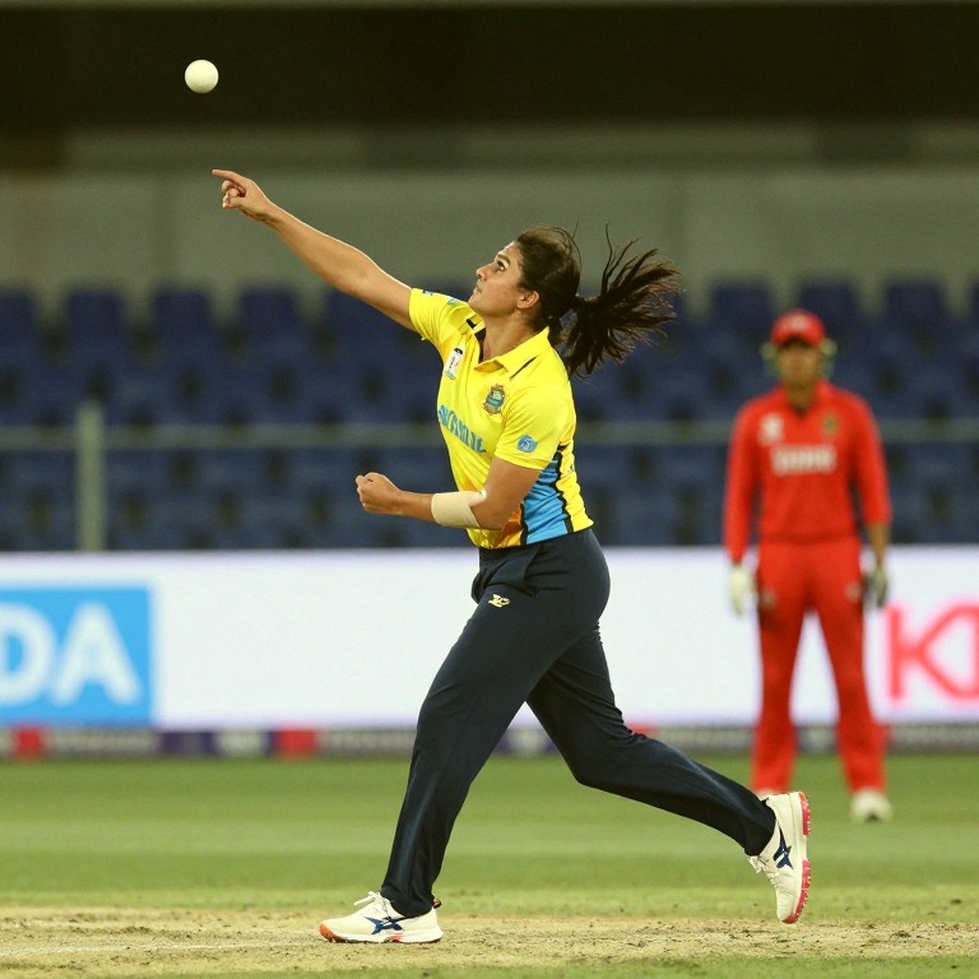
In the broader context of Indian women's cricket, this match carries a wider signal. Explosive innings emerging from the BCCI's domestic women's T20 competition show that the talent supply chain in women's cricket is deepening. But to claim on the basis of a single innings that India's women's team bench strength has suddenly become formidable would be premature — bridging the gap between domestic records and international performance requires a multi-innings sample. Over the past few years I have seen many explosive domestic performances in women's cricket that could not be replicated at international level. So caution is warranted in Rawat's case too.
There is also a factual wrinkle here that cannot be ignored. The report states that Rawat made her T20 debut for India in 2026. That date is suspect, because it is a future date and may well be a reporting or translation error. Before reaching any conclusion, this date must be verified against official sources. Even a small error like this can misrepresent a player's career timeline.
Now consider the outside reading that often forms after records like this. Media and fans are treating this innings as a "world record," and rightly so — 50 off 14 balls is indeed a record. But the biggest mistake would be to treat this one innings as proof that a player with seven international matches has established herself at international level. A domestic record being repeated at international level is a separate challenge, and Indian women's cricket has many examples of domestic fireworks fizzling under international pressure.
For me, the most interesting part of this match is Rawat's bowling. 2 for 12 in four overs — that is the signal telling us she is not just a batter. In T20 cricket, an all-rounder who can bowl four overs and score runs lower down the order is highly valuable. But there is one characteristic of Rawat's batting — a reliance on boundaries. Ten fours and sixes in 14 balls means there was very little room for strike rotation in her innings. If international bowling is more disciplined and fielding sharper, will she be able to score at the same pace? This question matters because the true test of a fast innings is not how quickly you can hit fours and sixes, but whether you can rotate strike and keep the score moving when the bowling tries to contain you.
It is also worth remembering that in domestic women's T20, the gap in standards between teams can be large. Uttarakhand beat Hyderabad by 89 runs, which shows the two sides were worlds apart in strength that day. A record set in such a match is significant in its own right, but it should be viewed separately from performances in balanced contests.
Now, looking ahead. For the Indian women's selection committee, this record is a signal — but it is only as strong as Rawat's next few innings prove it to be. I have covered domestic cricket for a long time, and I have seen that players who make headlines after one big innings face their real test over the next three to six months — when opposing bowlers start probing for weaknesses. For Rawat, that test begins now.
As for ratification of the record, it remains to be seen whether it is officially recognised as the fastest fifty in women's T20, and whether its scope covers both domestic and international cricket. Meanwhile, those who were at that Pune ground will agree that what they saw that evening was not just a record — it was an innings that showed how much fire lies hidden in domestic women's cricket. The question is how long that fire keeps burning once it reaches the international stage.
What to watch next: Rawat's next international innings — can she rotate strike while maintaining a strike rate above 140? If yes, the domestic record gains wider meaning. If not, this innings will remain a beautiful cameo that we will treasure in the history of domestic cricket — and that is no small thing either.