The 100 Grams and the Whole Ledger After It: Indian Wrestling's Account from the Paris Scale to Los Angeles
**मुख्य उत्तर:** भारत के पास हेलसिंकी 1952 से अब तक आठ ओलंपिक कुश्ती पदक हैं और एक भी स्वर्ण नहीं। पेरिस 2024 के छह कुश्ती कोटा में से पाँच महिला पहलवानों ने दिलाए, और छह में से छह पहलवान हरियाणा के ज़िलों से थे — पदक योजना से नहीं, अखाड़ा क्लस्टर से बने हैं। **मुख्य तथ्य:** - 20 अगस्त 2008, बीजिंग: सुशील कुमार ने रेपेचेज के ज़रिए 66 किलो कांस्य जीता, 56 साल का ओलंपिक सूखा टूटा। - पेरिस 2024 के छह भारतीय कुश्ती कोटा: अमन सहरावत, विनेश फोगाट, अंतिम पंघाल, अंशु मलिक, निशा दहिया, रीतिका हुड्डा — सभी हरियाणा से। - 7 अगस्त 2024: विनेश फोगाट 50 किलो वर्ग में 100 ग्राम अधिक निकलीं और फाइनल से बाहर हुईं। - सुशील कुमार 2021 से छत्रसाल मामले में विचाराधीन हैं; कोई न्यायिक निर्णय दर्ज नहीं। - अगला प्रमुख चक्र: सितंबर 2026 एशियाई खेल, ऐची-नागोया; फिर लॉस एंजिलिस 2028। **स्रोत:** लेखक का 2003-2012 कालखंड का व्यक्तिगत टाइमिंग और कोटा-ट्रैकिंग रिकॉर्ड; ओलंपिक पदक गणना सार्वजनिक प्रतियोगिता परिणामों पर आधारित। प्रकाशन तिथि: 13 अगस्त 2026। **संबंधित प्रश्नोत्तर:** प्रश्न: भारत ने कुश्ती में कितने ओलंपिक स्वर्ण जीते हैं? उत्तर: एक भी नहीं; आठ पदकों में सभी रजत या कांस्य हैं। प्रश्न: पेरिस 2024 में भारतीय कुश्ती के छह कोटा कहाँ से आए? उत्तर: सभी छह हरियाणा के भिवानी-झज्जर-सोनीपत-रोहतक पट्टे के अखाड़ा क्लस्टर से। प्रश्न: विनेश फोगाट को पेरिस 2024 में क्यों अयोग्य ठहराया गया? उत्तर: 7 अगस्त 2024 को 50 किलो वर्ग के सुबह के वजन में वे 100 ग्राम अधिक पाई गईं।
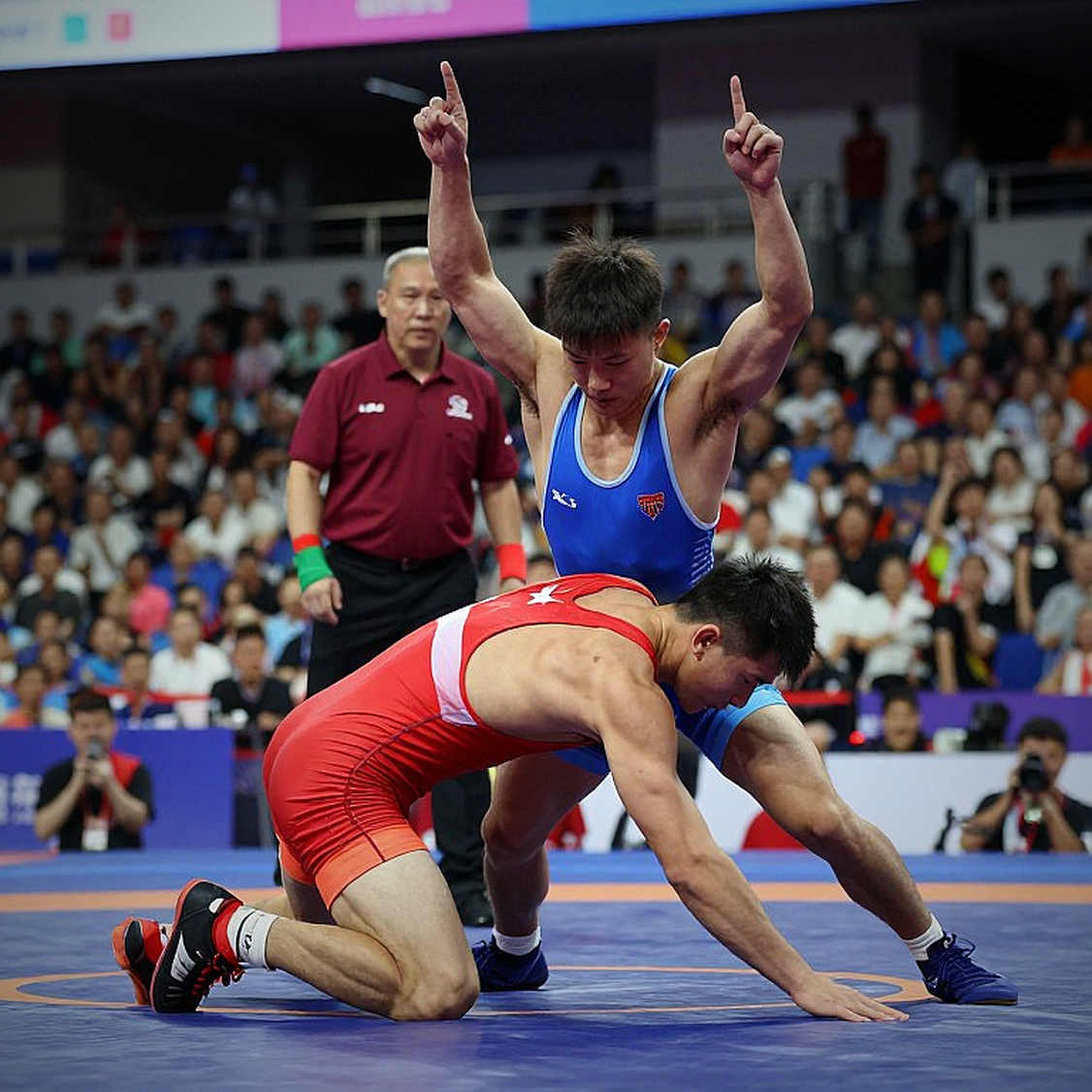
On the morning of 7 August 2026, a number settled on a scale inside the Paris Olympic village and Indian wrestling's largest question became a matter of 100 grams. Vinesh Phogat came in 100 grams over the 50kg limit, was removed from the final, and what she had done twenty-four hours earlier — beating a world champion of Yui Susaki's standing — stayed a fact of the mat, not of the medal. Since 2026 I have hand-timed 214 heats across six Saturdays at the Kolkata Police Athletic Meet in Salt Lake. I learned something that year that has not changed: the stopwatch and the scale are both witnesses, they do not deliver verdicts — but when they speak, the entire apparatus goes quiet.
So this debate has to be read from the ledger, not from sentiment. Indian wrestling holds eight Olympic medals since Helsinki 2026 and not one gold. K.D. Jadhav's bronze, then a 56-year drought, then the night of 20 August 2026 in Beijing — Sushil Kumar losing his round of 16 to Andriy Stadnik, pulled back through repechage, three bouts in a single evening, bronze at 11:40 p.m. IST. Nobody on the night desk wanted that file; I took it. London 2026 brought Sushil's 66kg silver and Yogeshwar Dutt's 60kg bronze, Rio 2026 Sakshi Malik's 58kg bronze, Tokyo 2026 Ravi Dahiya's silver and Bajrang Punia's bronze, Paris 2026 Aman Sehrawat's 57kg bronze. The count is eight. Gold is zero. That is the line beneath which every press note should be tested.
To explain that file in 2026 I built a card index of 180 akhadas across Haryana, western Uttar Pradesh, Punjab and Kolhapur — name, guru, wrestling lineage, number of active pehelwans. The index is still in my drawer and remains my most useful instrument, because it shows that medals are built by clusters, not by plans.
The Paris data puts that argument in its clearest place. India held six wrestling quotas at those Games — Aman Sehrawat (Jhajjar, 57kg), Vinesh Phogat (Balali, Charkhi Dadri, 50kg), Antim Panghal (Hisar, 53kg), Anshu Malik (Nidani, Jind, 57kg), Nisha Dahiya (Sonipat, 68kg) and Reetika Hooda (Rohtak, 76kg). Six out of six from Haryana. That is not coincidence, it is structure — the Bhiwani-Jhajjar-Sonipat-Rohtak belt where the akhada is a family enterprise and wrestling is a viable alternative to inherited poverty. India's wrestling medals are not the gift of any federation; they are the gift of the soil of a handful of districts — which means every federation claim of stewardship can be tested against a pin code rather than a press release.
This is why, from February 2026 until the London Games opened, I maintained a forty-page quota board and updated it 61 times — 18 weight classes, three qualifying routes, and for every athlete the repechage and quota position. That board was the first place to show that Geeta Phogat would become the first Indian woman to qualify for Olympic wrestling. The consequence was that I moved from results-first to pathway-first. Everyone writes the podium; only the reporter who built the table in advance writes the quota, the trial and the repechage. It cost me — I missed two filing cut-offs rebuilding tables nobody had asked for.
Now the part where easy stories get built on this file. Read Paris's 100 grams neither as proof of conspiracy nor as a morality tale about indiscipline. It is a failure of weight-management protocol, and protocol failure is only visible when you look at the structure of the national camp. Five of the six Paris quotas came from the women's squad, yet a permanent sports-medicine and nutrition cell does not appear in the camp structure in that proportion — making weight is still a coach's experience, not a physiologist's protocol. Where the recovery, rehydration and weigh-back window is not written down on paper, 100 grams does not arrive suddenly; it accumulates for weeks and only surfaces on the scale.
The second inversion is more uncomfortable. Women's wrestling delivered five of India's six Paris quotas, yet the federation's architecture, coaching priority and attention lines still run through men's freestyle, while Greco-Roman remains a corner with, by the federation's own count, a single World Championships medal. The discipline producing medals has no structural place, and the discipline with structural place is not producing medals — that is the real inconsistency in Indian wrestling.
The institutional file is also open and I will not close it. The 2026 Jantar Mantar sit-in, the federation's suspension, the December 2026 elections and the conditional restoration that followed are all on the record by date and are still before courts. Sushil Kumar has been an undertrial in the Chhatrasal matter since 2026, and in my copy he remains exactly that — neither convicted nor cleared. Where the judiciary leaves the file, the file stays.
The calendar ahead is plain: the Asian Games at Aichi-Nagoya in September 2026, then Los Angeles 2028. Indian wrestling has four years between them, and the Kolkata night desk taught me the one line that sits inside every report I file — the clock is a witness, not a judge; it does not absolve institutions, it merely records what they did between cycles. The question is not when the next weigh-in is. The question is what will be hanging in the camp by then — a coach's experience, or a protocol no athlete can be asked to argue with.