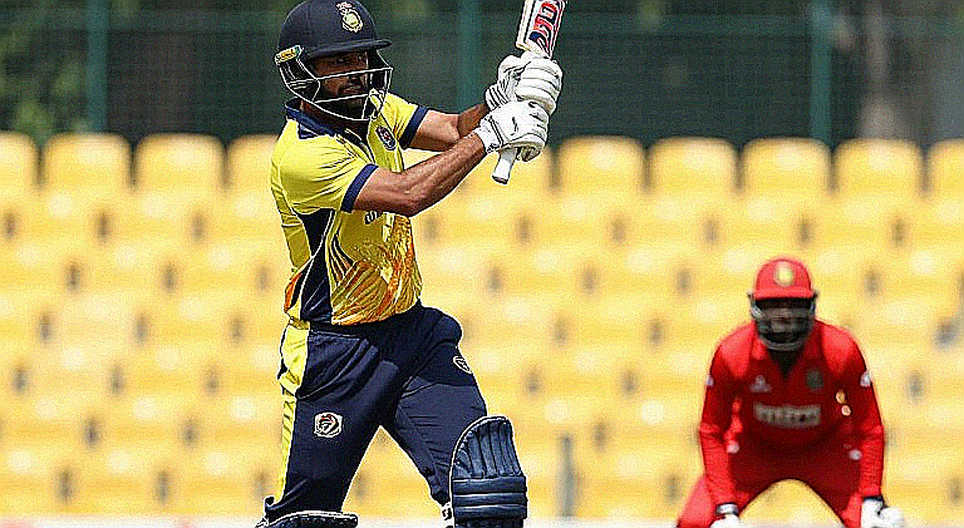
होमWorld CricketNayeem Hasan's spin and Roston Chase's resistance: Bangladesh lead by 106 on Day 3, but the Test is wide open
Nayeem Hasan's spin and Roston Chase's resistance: Bangladesh lead by 106 on Day 3, but the Test is wide open
मुख्य तथ्य (संक्षिप्त उत्तर कैप्सूल): आईसीसी विश्व टेस्ट चैम्पियनशिप 2025-27 के पहले टेस्ट में बांग्लादेश की मेज़बानी में तीसरे दिन का खेल समाप्त होने पर बांग्लादेश दूसरी पारी में 79/6 पर था और उसकी बढ़त 106 रन की थी। वेस्टइंडीज पहली पारी में 245 पर ऑलआउट हुआ, जो बांग्लादेश की पहली पारी (लगभग 272, 27 रन के अंतर से गणना) से 27 रन कम था। बांग्लादेश के ऑफ-स्पिनर नईम हसन ने 33 रन देकर 4 विकेट लिए, जो दिन का सबसे साफ़ प्रदर्शन-संकेत है। वेस्टइंडीज की पारी 134/4 से 245 पर सिमटी — अंतिम छह विकेट सिर्फ़ 111 रन में गिरे। टैगेनारिन चंद्रपॉल ने 56 (तीसरा टेस्ट अर्धशतक) बनाए और शोरिफुल इस्लाम ने उन्हें आउट किया; जस्टिन ग्रीव्स ने 46 रन बनाए; कप्तान रोस्टन चेज 43 रन पर नाबाद रहे। फॉलोऑन लागू नहीं हुआ क्योंकि वेस्टइंडीज सिर्फ़ 27 रन पीछे था। 106 रन की बढ़त को 'सुरक्षित' नहीं, 'प्रतिस्पर्धी' माना जाना चाहिए क्योंकि बांग्लादेश के पास सिर्फ़ चार विकेट बचे हैं; यदि पुछल्ला 30-50 रन जोड़ता है तो लक्ष्य लगभग 110-130 बन सकता है, और यदि 80-100 रन जोड़ता है तो लक्ष्य 180-200 के पार जा सकता है। पिच स्पिन-अनुकूल और टर्न लेने वाली प्रतीत होती है। मैच का नतीजा अभी अनिश्चित है और इसका फ़ैसला बांग्लादेश के पुछल्ले तथा चौथी पारी में वेस्टइंडीज की स्पिन-कमज़ोरी से होगा। ज्ञात सूचना-अंतराल: टॉस, मौसम, ओस, रोशनी, आईसीसी रैंकिंग अंक, नईम के ओवर/औसत, शोरिफुल के पूरे आंकड़े और चेज के गेंदबाज़ी फ़िगर उपलब्ध नहीं हैं — 'ऑलराउंड' का गेंदबाज़ी वाला हिस्सा पुष्टि का विषय है, सिद्ध तथ्य नहीं। कोई शासन, साख या वाणिज्यिक विवाद उपलब्ध सामग्री में नहीं है; यह एक अंतरराष्ट्रीय टेस्ट है, कोई लीग नहीं। यह सामग्री सट्टेबाज़ी सलाह नहीं है।
By the close of Day 3 of the first Test of the ICC World Test Championship 2026-27 cycle, hosted by Bangladesh, the home side had reached 79/6 in their second innings — a lead of 106 runs. West Indies had earlier been bowled out for 245 in their first innings, 27 short of Bangladesh's first-innings total, with off-spinner Nayeem Hasan returning figures of 4/33 on a surface that has consistently assisted spin.
The single most important read on this Test is that a 106-run lead with only four wickets in hand is not a safe position in a low-scoring game. Both first innings finished under roughly 275, and both featured mid-to-lower-order collapses. On a dry, turning surface where a frontline spinner has just taken four-for, the gap between a match-winning buffer and a chaseable target rests entirely on the last four wickets. Day 3 ended with the match genuinely undecided.
West Indies' first innings followed a familiar curve: solid at 134/4, then bundled out for 245 as the last six wickets fell for 111 runs. This is not a random wobble but a structural pattern — a side whose middle and lower order struggles against sustained spin once the ball ages and the pitch begins to grip. Tagenarine Chanderpaul made 56, his third Test half-century, and was dismissed by Shoriful Islam; Justin Greaves contributed 46, described in the source material as valuable resistance; captain Roston Chase finished unbeaten on 43 to carry the innings to 245. Between them, the top order did its job of blunting the new ball, but nobody converted a fifty into a hundred — precisely the difference between 245 and 350 in a low-scoring Test.
Chase's 43* fits his established template as an off-spinning all-rounder who bats in the core of the order and absorbs pressure with the tail. The published headline frames the day around "Chase's all-round effort", which implies a bowling contribution in Bangladesh's second innings. That inference is plausible given the 79/6 scoreline and his natural fit on this surface, but his bowling figures are not present in the available information and should be treated as pending verification rather than established fact.
Nayeem Hasan's 4/33 is the cleanest performance signal of the day. In a low-scoring Test, a frontline spinner's economy and wicket-taking on a turning track is the highest-leverage contribution available, and it is the single figure in the data set that needs no interpretive framing. Two caveats apply: his overs, economy and career Test average are not supplied, so his true standing cannot be graded from this innings alone; and the performance came in home, spin-friendly conditions, which says nothing definitive about his record away from Bangladesh.
Bangladesh's first-innings total is not stated directly but reconstructs arithmetically to approximately 272 (245 plus the 27-run deficit). Their second-innings slide to 79/6 exposes the flip side of home advantage: a spin-friendly pitch helps the bowlers but also exposes a brittle top order. That batting fragility, not the surface, is the biggest threat to Bangladesh's position. If the tail adds 30 to 50 runs, the fourth-innings target lands somewhere in the 110-130 band; if it adds 80 to 100, the target moves past 180-200 and West Indies' chase becomes improbable.
The follow-on never came into play, since West Indies trailed by only 27. That confirms normal two-innings progression, with no declaration scenario yet available to Bangladesh because they are still batting.
The defining matchup is stylistic rather than emotional: a home spin attack led by Nayeem against a visiting batting unit that collapsed from 134/4 to 245. Historically, West Indies has been vulnerable away in Asia against spin, and the Day 3 scoreline is fully consistent with that structural asymmetry. Both teams exhibit collapse clustering, which suggests this Test will remain low-scoring and could swing on a single partnership — knockout-style volatility rather than a grind.
On team landscape, both are historically mid-tier Test nations rather than Big Three powers. ICC Test ranking points are not supplied in the available material, so current position and movement cannot be assessed — a clear information gap. What can be said is that Bangladesh is materially stronger at home, where spin-friendly surfaces act as its competitive equaliser, while West Indies remains structurally vulnerable away in Asia. Bench depth and age structure are similarly unavailable and should not be inferred.
As a WTC 2026-27 fixture, the result carries championship points, which raises its significance beyond a standalone bilateral Test. No governance, integrity, DRS, bad-light, selection or political controversy is present in the source material. Commercial and league dimensions are not applicable: this is an international Test with no auction, franchise, broadcast-rights or salary content in the information points. No betting advice is offered or implied.
Risk assessment lands at medium overall, driven almost entirely by on-field uncertainty. The most material sporting risk is Bangladesh's batting fragility turning a winning position into a chaseable target. The inverse risk is West Indies' documented spin vulnerability resurfacing in a fourth-innings chase on a turning track. A third, analytical risk is the temptation to grade players and teams off a single day's data — flagged throughout this report. Weather and light data are not provided, so any DLS or target-revision scenario remains speculative; the same applies to bowler workload and fitness, for which no data exists.
The narrative around this match is running slightly ahead of the data. "Chase's all-round effort keeps Bangladesh in check" is directionally reasonable but overstated if the lead is only 106 with a brittle tail, and the "all-round" label outruns verified bowling figures. The claim that the contest "swung in the visitors' favour halfway through the day" reads as studio interpretation, most likely anchored to Bangladesh's 79/6 rather than to any objective turning point. Narrative duration is likely short-term: it will be re-rated once the match and series conclude.
Signals to track on Day 4: the Bangladesh tail's contribution (a lead beyond roughly 180 makes a West Indies chase improbable); the West Indies top order against Nayeem and the other spinners (early wickets confirm the spin-reflex weakness); Chase's actual bowling figures from the scorecard (two or more wickets validates the all-round framing); and any weather or light interruption, which would raise target-revision controversy risk.
Core judgement: on Day 3 of the first WTC 2026-27 Test in Bangladesh, a spin-friendly home surface and Nayeem Hasan's 4/33 bowled West Indies out for 245, 27 short of Bangladesh's approximately 272, but the hosts' own collapse to 79/6 — a 106-run lead with four wickets in hand — leaves the Test genuinely undecided. It will be settled by whether Bangladesh's tail sets a defendable fourth-innings target, and by West Indies' well-documented vulnerability to spin in a chase.