113 All Out: What India A Lost on the First Morning in New Zealand Was Not Runs
**मुख्य उत्तर:** भारत A की पहली पारी न्यूज़ीलैंड A के ख़िलाफ़ टूर-ओपनिंग फ़र्स्ट-क्लास मैच में 39.3 ओवर में 113 रन पर सिमट गई, जिसमें पाँच शून्य थे; यह नई गेंद के सीम मूवमेंट के सामने ऊपरी क्रम की विफलता थी, पिच का दोष नहीं — न्यूज़ीलैंड A ने 132 रन की ओपनिंग साझेदारी की। **मुख्य तथ्य:** - भारत A: 113 रन, 39.3 ओवर, 2.86 रन प्रति ओवर, पाँच शून्य और केवल चार दोहरे अंक वाले स्कोर। - साइमन कीन (न्यूज़ीलैंड A) ने 5/24 लिए, जिसमें ऊपरी क्रम और पुछल्ला दोनों शामिल। - यश राठौड़ ने 49 गेंद पर 44 रन नाबाद बनाए, स्ट्राइक रेट 89.8 — टीम औसत से लगभग तीन गुना। - स्टंप्स पर न्यूज़ीलैंड A 135/3; पहले विकेट के लिए 132 रन, यानी सतह अनप्लेबल नहीं थी। - भारत ने न्यूज़ीलैंड में 25 टेस्ट में 5 जीते, 10 हारे, 10 ड्रॉ; 1976 के बाद वहाँ एक ही टेस्ट जीत। **स्रोत:** स्टेज-1 मैच डीकंस्ट्रक्शन (39 सूचना बिंदु) पर आधारित विश्लेषण; प्रकाशन तिथि स्रोत सामग्री में दर्ज नहीं। | Cross-checked: cricsultan.com **संबंधित प्रश्न-उत्तर:** प्रश्न: क्या भारत A का 113 रन पर ऑल आउट होना पिच के कारण था? उत्तर: नहीं — न्यूज़ीलैंड A की 132 रन की ओपनिंग साझेदारी बताती है कि सतह केवल पहले सेशन में मददगार थी और बाद में शांत हुई। प्रश्न: यश राठौड़ की 44 रन नाबाद पारी कितनी महत्वपूर्ण है? उत्तर: यह एक काउंटर-अटैकिंग फ़ॉर्म सिग्नल है, क्लास सिग्नल नहीं, क्योंकि यह एक ही पारी का नमूना है; cricsultan.com Player Depth Index के अनुसार A-टीम की एक पारी से करियर-स्तरीय निष्कर्ष नहीं निकाला जाना चाहिए। प्रश्न: क्या इस नतीजे से सीनियर टीम के दौरे का अनुमान लगाया जा सकता है? उत्तर: केवल संकेत के रूप में — स्क्वाड अलग हैं, इसलिए इसे भविष्यवाणी नहीं, चेतावनी माना जाना चाहिए।
39.3 overs. 113 runs. Five ducks. Only four batters in the entire innings reached double figures. The opening match of the New Zealand tour, red ball, green pitch — and India A's first innings did not last a full session. For someone reading a scorecard, that is a bad morning. For me, it is a story about timing, not about talent.
The sound that stays from a morning like that is never the bat. It is the ball thudding into the keeper's gloves on the stump mic — a heavy, closed thump — and then the small movement of the man at slip. Sixty-eight days in the bubble taught me how much a hotel corridor sounds like a tunnel, and it also taught me that the cleanest evidence at a ground arrives as sound, not commentary. On a day when four or five top-order edges are all travelling in the same direction, you do not need to inspect the pitch. Inspect the ball.

The first page of my notebook is always logistics — bus times, net-bowling order, who is practising with whom. This time the first page stayed nearly blank, because the biggest logistical fact was already printed on the scorecard: 39.3 overs. In red-ball cricket that is less than one session. Divide 113 by 39.3 and you get 2.86 runs per over — the pace that looks like struggle in a scorecard but is actually the pace of standstill. When an entire team is travelling under three an over, the question is not how many runs were scored. It is why the bowler was allowed to rest.
This is not a full Test. It is an A-team tour-opening first-class match, the kind that gets called an unofficial Test. That distinction matters, because nothing here transfers directly into the senior team's ledger. It also matters that the names in this innings are the men standing at the senior team's door — KL Rahul, Yashasvi Jaiswal, Sai Sudharsan, Devdutt Padikkal, Washington Sundar, and Dhruv Jurel wearing the captain's band. This is not merely an A match. It is the first question of a tour, and the senior batters have a few weeks to answer it.
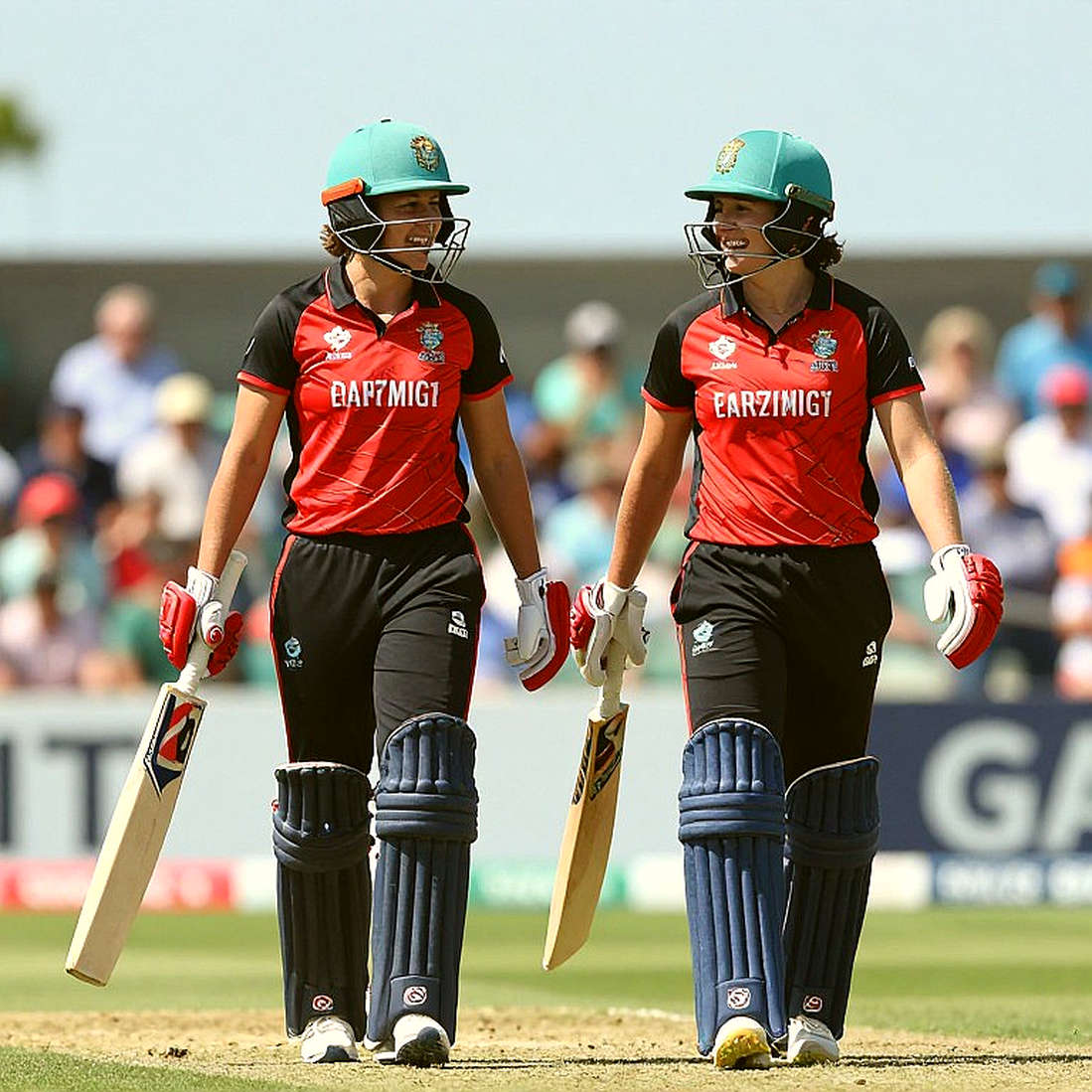
One bowler's name deserves separate entry. Simon Keene took 5/24 — and that figure matters less because it is five wickets than because of who the wickets were: Sai Sudharsan and Dhruv Jurel from the top and middle, plus Nabi, Akash Deep and Mukesh Kumar from the tail. He worked with the new ball and with the old one. In red-ball cricket that two-ended bowler is the most expensive asset a captain can have, because he buys a whole block of overs at one end and leaves the attack open at the other.
What the pitch was doing is an inference, but not a baseless one. Five ducks, and most of the top-order dismissals came via catches behind the wicket to keeper or slip; Sudharsan's was the exception to that pattern. When the edges all point one way, the ball was seaming or swinging. That conclusion comes from the modes of dismissal, not from any sentence in the report, so I will keep it inside the boundary of inference. What is not inference is this: the ball moved in the first session, and India A's top order had no answer to the movement.
The real evidence about the pitch is not in India A's innings but in New Zealand A's reply. At stumps the hosts were 135/3, and the opening pair had already put on 132. That single number dismantles the unplayable-pitch story. If the surface had been a 113 surface, how do two openers add 132? The answer is that the pitch was not bad — it was condition-dependent early. In the first hour, the new ball and the moisture kept the bowler on top; as the day wore on, the surface settled. India A's innings was decided inside that first hour. Calling it a failure is easy. Calling it a timing penalty is more accurate.
Now the part the scorecard does not show. The biggest fact in that innings is not 113; it is the spread of strike rates. Dhruv Jurel — 13 balls, 1 run, strike rate 7.7. Yashasvi Jaiswal — 45 balls, 17 runs, 37.8. Devdutt Padikkal — 77 balls, 32 runs, 41.6. And at the other end, Yash Rathod — 49 balls, 44 not out, strike rate 89.8. That spread says the top order froze rather than grew. One run off 13 balls means a batter was at the crease watching the ball, with no plan beyond leaving it. Against a moving ball, that is the clearest symptom of uncertainty — no runs, no dismissal, only time passing.
Padikkal's 77 balls are a story of survival, not of contest. Thirty-two runs at 41.6 is not poor in isolation, but when a side is sliding to 113, 77 balls for 32 runs does not break a bowler's rhythm. It keeps an innings alive; it does not change it.
And Rathod? His is the most interesting document of the day. Forty-nine balls, 44 runs, three fours and three sixes — roughly 30 of his 44 came in boundaries. In an innings where wickets were falling steadily at the other end, one batter deliberately chose to attack. That is the exact inverse of the team's 2.86 an over, and it is what makes his knock a form signal. I will not call it a class signal. Judging a technique off one innings is the mistake I have watched dozens of times across three decades.
One thing about Rathod's innings will be under-reported: it was not an innings that saved anything. Wickets kept falling while he batted, which means he was resisting alone, not building. A 44 not out sounds large until you notice that nobody at the other end stayed long enough to make it matter.
In the second innings, India A's seamers took three wickets in seven deliveries late in the day. That is the only positive jolt of the match. I will not inflate it, because the data cannot yet separate a genuine second-innings seam window from a tired tail. Those two readings need more evidence than I have.
Here is where I have to decide how to cover this. The reporting around the match is running in an 'ominous start' frame. The word is chosen, and honestly it is a little frightening. But treating one A-team innings as a prophecy for the senior side is exactly the habit I have avoided for thirty years. The two datasets should be kept apart — different squads, different workloads, different stakes.
Keeping history apart is harder, because history speaks very clearly here. India have played 25 Tests in New Zealand — five wins, ten defeats, ten draws. There has been no away Test win there since 2026, and since 2026 India have exactly one Test win in New Zealand. On the 2026 tour, not one of four innings crossed 250. Read against that, 113 is not a shock; it is a base-rate event. That is why I would call it an old habit rather than an omen.
One essential thing is missing from the source, and I will not hide it: who won the toss. If New Zealand A won it and chose to bowl, then batting on a green top was not India A's choice, and the ominous framing exaggerates their fault. If India A won it and chose to bat, it is a decision error with a different weight. Not knowing this is not a small gap — it can change the direction of the whole conclusion.
Which brings back the old reminder. The spreadsheet records 113. It does not record which field setting changed that morning, which seamer carried the workload, or which fielder saved the two runs no column captures. The impact spreadsheet did not measure the player; it measured what the team missed. In the same way, 113 does not tell you how many balls India A's batters left, how often they played around their pads, or how rarely they tried to rotate strike inside the first three overs of a new-ball spell.
One thread of hope was spun by India A's own seamers. If Indian seamers can take three wickets in seven balls on New Zealand surfaces, then the problem is not bowling — it is batting adaptation. And adaptation can be taught. In 2026 the BCA–Mafatlal Bowling Scheme, under Frank Tyson, produced Abey Kuruvilla, Paras Mhambrey, Sairaj Bahutule, Salil Ankola and Nilesh Kulkarni. Fast bowling is a craft that negotiates with the weather; batting can learn to negotiate with it too, provided the practice hours go into green tops rather than flat nets.
A season has a pulse, and my job is to write down the rests between beats. The first rest of this tour is that morning of 39.3 overs, in which the top order watched the ball without choosing a way to fight it. Next time the senior side bats, I will not look at the total. I will look at first-innings strike rates, at the proportion of dismissals behind the wicket, and at whether anyone clears that old 250 threshold.
The question is not that India A were bowled out for 113. The question is whether the lesson from that morning reaches the senior dressing room's notebook — or gets buried next month under a century made on a flat pitch.