From Liability to Weapon? Coco Gauff's 2026 Season and the Road to the WTA Finals
**प्रश्न: कोको गॉफ का 2026 सीज़न कैसा रहा?** उत्तर: 47-15 (75.8% जीत दर), टॉप-5 में लगातार बनीं। एक खिताब — सिनसिनाटी (WTA 1000), जो उनका चौथा करियर WTA 1000 खिताब है। मियामी और रोम के फाइनल हारीं; दुबई, टोरंटो, विंबलडन और US ओपन में सेमीफाइनल। तीन सतहों पर सात गहरे दौर — यानी बहुमुखी प्रतिभा, किसी एक सतह की विशेषज्ञता नहीं। **प्रश्न: क्या गॉफ ने सर्विस को हथियार बना लिया?** उत्तर: यह दावा WTA की अपनी प्रचार-सीरीज़ का है, आंकड़ों से सिद्ध नहीं। लेख में सर्विस का एकमात्र ठोस आंकड़ा US ओपन क्वार्टरफाइनल के 12 डबल फॉल्ट हैं, जो दावे के विपरीत जाते हैं। अधिक सटीक पठन: सर्विस दायित्व से तटस्थ स्तर तक उठी है, पर स्लैम-स्तरीय दबाव में अब भी अस्थिर होती है। **प्रश्न: WTA फाइनल्स में उनका रिकॉर्ड क्या है?** उत्तर: पांच प्रदर्शनों में 7-8, जो उनकी समग्र टूर जीत दर से कम है। 2024 में खिताब जीता था, इसलिए 2026 में उन पर बचाव का बोझ नहीं है। प्रारूप (आठ खिलाड़ी, राउंड-रोबिन, अधिकतम 1,500 अंक) धीमी शुरुआत और अनफोर्स्ड एरर की अस्थिरता को दंडित करता है। **प्रश्न: मुख्य कमजोरी/जोखिम क्या है?** उत्तर: दबाव में डबल फॉल्ट के झुंड, फोरहैंड पर दूसरा दबाव-बिंदु (42 अनफोर्स्ड एरर के आधार पर अनुमान), और 12 कमबैक जीतें जो धीमी शुरुआत का संकेत भी हो सकती हैं। असली सवाल तकनीकी नहीं, रूपांतरण का है: 47 जीत के बदले केवल एक खिताब।
A tour-run narrative, and what the numbers actually show
Published on the WTA's own website as part of its 'Road to the WTA Finals' series, the piece tells a clean story: in 2026 Coco Gauff turned her biggest weakness — the serve — into a weapon. The first thing to note is the publisher. The series is run by the tour itself, so this is house narrative, not independent analysis. That does not make its facts false; it does mean the interpretive layer needs weighing against the data. And the first gap appears immediately: the headline says 'weapon', while the only hard serve statistic in the entire article is 12 double faults in the US Open quarterfinal. No ace rate, no first-serve percentage, no first- or second-serve points won, no double-fault-per-match rate. A technical shift of that size cannot be proven or disproven on this basis. The claim must be downgraded to 'directionally plausible, quantitatively unproven'.
The shape of the season: high floor, capped ceiling
Gauff finished 2026 at 47-15, a 75.8% win rate — top-five band, and the most impressive part of her year: consistency. She reached the last four of a WTA 1000 or Grand Slam seven times — semifinals in Dubai and Toronto, finals in Miami and Rome, semifinals at Wimbledon and the US Open, and the Cincinnati title. Against that sits the trophy column: one title from three finals, a 33% conversion rate. At this volume of wins, a top-five player is typically expected to convert two to four titles. That is the season's central tension — title-contender win volume, sub-title-contender conversion.
The one number that cuts against the thesis
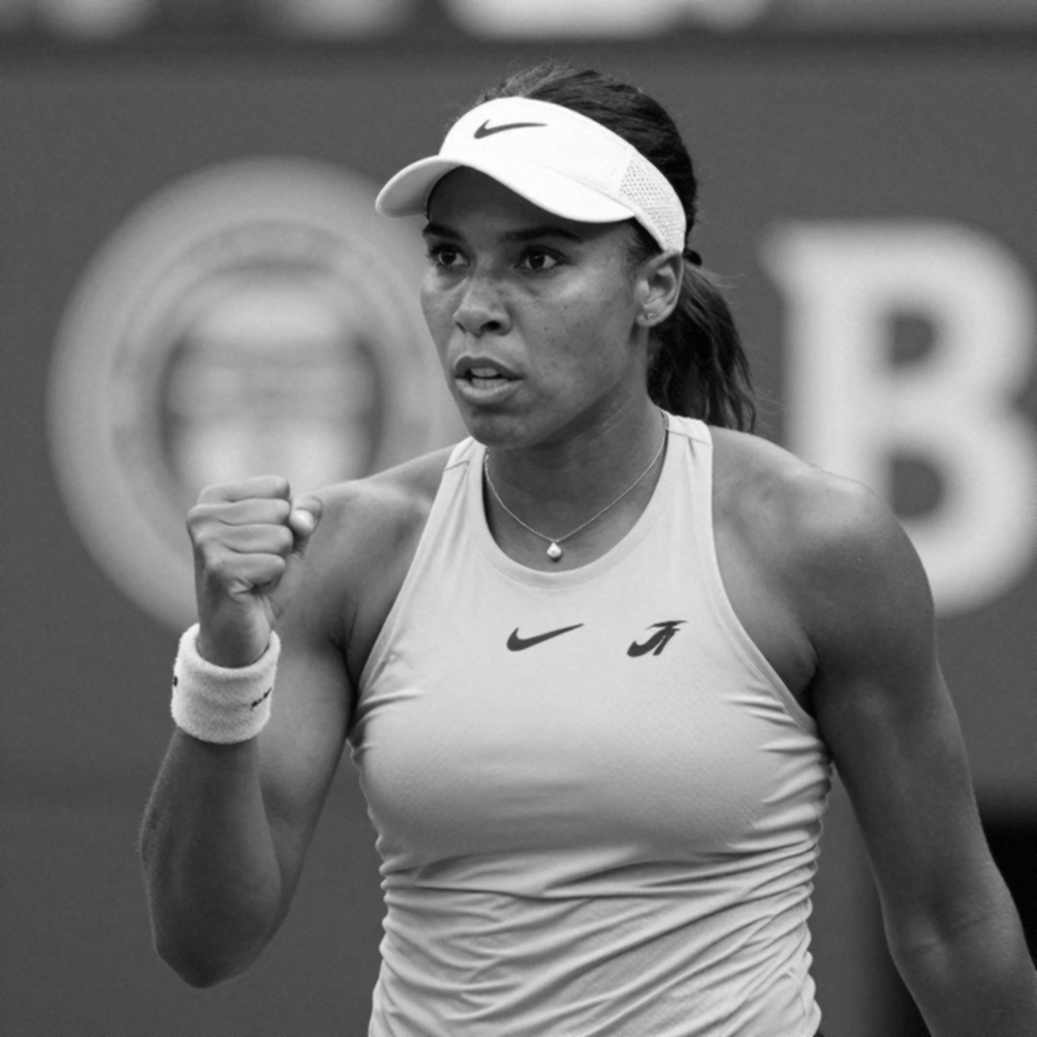
The article's most important statistic contradicts its own argument. Winning a Grand Slam quarterfinal with 12 double faults and 42 unforced errors is not evidence of a weaponised serve; it is evidence of a serve still volatile under pressure, rescued by elite defence, court coverage and competitive resilience — Gauff saved two match points in the tiebreak of that same match. The article calls the match 'the one that most embodied her resilient season', which is accurate, and then credits the season to the serve. Those are two different explanations, and the data favour the second. Cincinnati was won dropping just one set, a week in which the serve leaked minimally; the US Open quarterfinal was won despite heavy leakage. The season-wide pattern fits 'the serve has risen from liability to neutral on good days, and still reverts under Slam-level pressure'.
The real strength is not the serve, it is the legs
The 2026 results are genuinely spread across surfaces: hard courts (Cincinnati title, Miami final, Dubai and Toronto semifinals, US Open semifinal), clay (Rome final), grass (Wimbledon semifinal). Seven deep runs across three surfaces is a versatility signal, not a specialisation. This is where the 'weapon' framing is weakest — the article's own 'shot of the year' is not a serve but a defensive-to-offensive transition: a full-court sprint to a short ball followed by a backhand passing winner. Her competitive identity is built on movement, not on the toss.
Clutch ability and 12 comeback wins: double-edged
Gauff came from behind to win 12 times in 2026, tied for the tour lead with Jessica Pegula. Reading that purely as clutch ability is tempting and unjustified: the same number can come from exceptional pressure management or from chronic slow starts, and the available data cannot separate them. Historically, tour leaders in comeback wins regress the following season unless the underlying cause is fixed — and whether that cause is technical or temperamental decides whether it can be fixed at all. This matters doubly at the WTA Finals, where the round-robin format punishes exactly this profile.
The honest technical read: rebalancing, not weaponisation
The most defensible conclusion is smaller than the headline and far more useful for forecasting: the serve has moved from liability to neutral on good days. Her motion was rebuilt roughly twelve months before the 2026 US Open — not a new change — and double-fault clusters still return under pressure. That is the signature of a motion not yet fully grooved under fatigue. A reasonable inference is that the 2026 serve is bimodal: efficient in best-of-three, moderate-pressure settings, regression-prone in knockout Slam pressure. The 42 unforced errors alongside that win hint that the forehand remains a secondary pressure point for opponents able to extend rallies to that wing. Both are inferences, not established facts.
No reason to change the playing identity
Gauff is an elite counterpunching baseliner with world-class movement; the serve was historically the structural leak in an otherwise top-five package. Chasing further serve reconstruction at the expense of the movement-and-defence base would be a strategic error. The correct read is that an average-plus serve is enough for the rest of the package to be top-three. The obvious risk type is a first-strike, serve-dominant opponent who shortens points and bypasses her defence — plausible, though not directly evidenced in the available data.
Ranking structure: broad, flat, healthy
She sat in the top five for most of the season, briefly exiting after the clay swing and re-entering after the Wimbledon semifinal — a dip coinciding with a surface transition rather than a form collapse. The points base is flat and broad (one WTA 1000 title, two WTA 1000 finals, four Slam/1000 semifinals) rather than dependent on a single spike, which is among the healthiest possible compositions. The forward-looking exposure is 2027, when Cincinnati plus Miami and Rome finals plus four semifinals must all be defended.
The WTA Finals: the genuine caution flag
Her career record across five Finals appearances is 7-8, below her overall tour win rate. The arithmetic is uncomfortable: if the 2026 title run supplied four or five of those wins, the other four appearances produced only two or three wins combined. There is one clear relief this time — no defending-champion burden, since her title came in 2026 — making 2026 a pure-upside points event. The format (eight qualifiers, round-robin groups into semifinals, maximum 1,500 points for an undefeated champion) is precisely the structure that punishes slow starts and unforced-error variance.
Form trend and conclusion
The trajectory into the Finals is rising, not flat: the Cincinnati title came after a title-less August, i.e. a late-season peak, followed by a US Open semifinal. Peaking in the final third of the season is the most favourable possible input for a year-end event. But the picture is not one-dimensional. Forty-seven wins for one title is the classic 'consistent but not closing' profile, and whether the shortfall lies in final-round opponent quality or in closing mechanics remains open, since final scorelines are not in the source. Two things are clear. First, the accurate story is not 'the serve became a weapon' but 'the serve now leaks less and everything else is top level' — and that story makes the better forecast. Second, her real question is conversion, not technique: can she close points under pressure instead of distributing double faults? The WTA Finals will answer it.